
La Galleria delle Applicazioni raccoglie un'ampia varietà di tutorial e di app dimostrative realizzati con COMSOL Multiphysics in diversi ambiti applicativi, inclusi quelli elettrico, meccanico, fluidico e chimico. E' possibile scaricare i file dei modelli e delle app demo pronti all'uso e le istruzioni step-by-step per costruirli, e utilizzarli come punto di partenza per le proprie simulazioni.
Lo strumento di Ricerca Rapida permette di trovare i modelli che si riferiscono alla propria area di interesse.
Si noti che molti degli esempi qui presentati sono accessibili anche tramite le Librerie delle Applicazioni incorporate nel software COMSOL Multiphysics® e disponibili dal menu File.
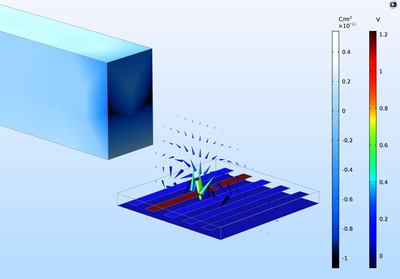
This tutorial model explains how to extract lumped matrices by means of the Stationary Source Sweep study. The capacitance matrix of a five-terminal system is used to infer the position of a metallic object rather like real-world capacitive position sensors. The example illustrates the ... Per saperne di più
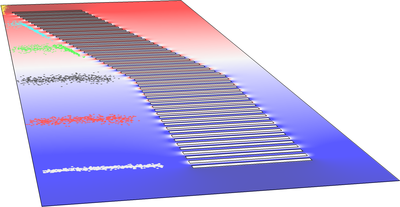
An electrodynamic ion funnel provides an efficient means of transferring ions from regions of high pressure to high vacuum. The ion funnel can couple devices which generally operate at pressures of different orders of magnitude, such as ion mobility spectrometers and mass spectrometers, ... Per saperne di più

This model illustrates the use of COMSOL Multiphysics for modeling of ionic current distribution problems in electrolytes, in this case in human tissue. The problem is exemplified on a pacemaker electrode, but it can be applied in electrochemical cells like fuel cells, batteries, ... Per saperne di più
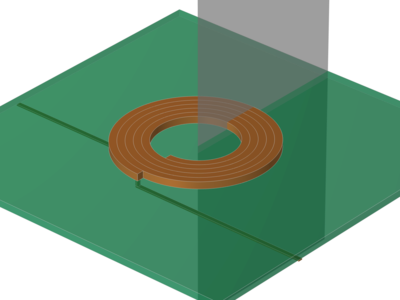
At the resonance frequency, the capacitive coupling between the turns causes the impedance of a coil to transition from inductive to capacitive. This application analyzes the resonance of a 5 turn spiral coil of copper equipped with a thin epoxy varnish insulation layer. The capacitive ... Per saperne di più
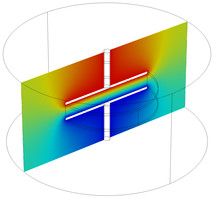
A capacitor with an applied sinusoidally time-varying voltage difference is modeled. A wide frequency range is considered and the impedance of the device is computed. Solver accuracy is addressed. The relationship between the frequency domain impedance and the steady-state capacitance ... Per saperne di più

Every electrical device has some resistance. That is, when a voltage difference is applied across any two terminals of the device, there will be a directly proportional current flow. This model demonstrates how to compute the resistance of a short section of copper wire. The convergence ... Per saperne di più
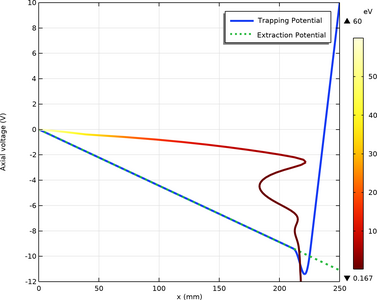
A radio frequency quadrupole ion trap utilizes a radio frequency quadrupole (RFQ) in order to trap an ion beam. A continuous high energy ion beam is first cooled and converted into a spatially confined bunch, which can then be released with minimal heating of the beam. The device is also ... Per saperne di più
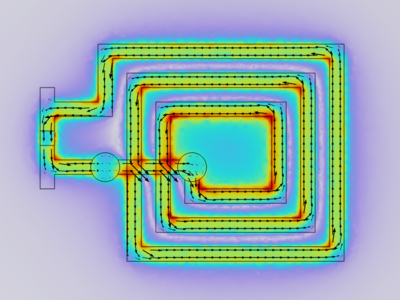
This tutorial example shows how to use the Electric Currents in Shells interface together with Magnetic Field interface to compute the resistance and inductance of a planar PCB coil in the stationary regime. Per saperne di più
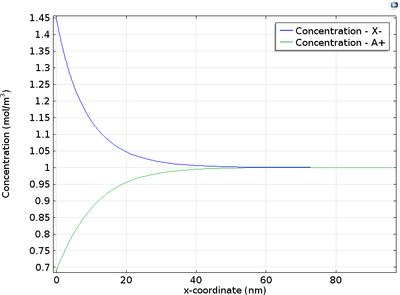
At the electrode-electrolyte interface, there is a thin layer of space charge in a diffuse double layer. This may be of interest when modeling devices such as electrochemical capacitors and nanoelectrodes. This tutorial example shows how to couple the Nernst-Planck equations to the ... Per saperne di più
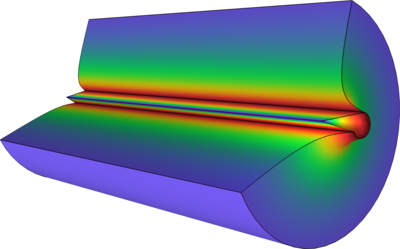
This introduction model creates a simple model of the magnetostatics problem with a wire of infinite length carrying current, which is commonly found in textbooks. Since there is an analytical solution to this problem, the model can be used to compare theory with numerical results from ... Per saperne di più


