
La Galleria delle Applicazioni raccoglie un'ampia varietà di tutorial e di app dimostrative realizzati con COMSOL Multiphysics in diversi ambiti applicativi, inclusi quelli elettrico, meccanico, fluidico e chimico. E' possibile scaricare i file dei modelli e delle app demo pronti all'uso e le istruzioni step-by-step per costruirli, e utilizzarli come punto di partenza per le proprie simulazioni.
Lo strumento di Ricerca Rapida permette di trovare i modelli che si riferiscono alla propria area di interesse.
Si noti che molti degli esempi qui presentati sono accessibili anche tramite le Librerie delle Applicazioni incorporate nel software COMSOL Multiphysics® e disponibili dal menu File.
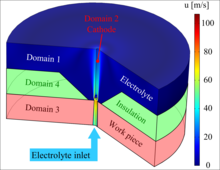
For several high-precision applications, especially in hydraulic systems and fuel injectors, micro bores are needed. In most cases the shape of the injection hole, especially the edge rounding, has a significant influence on the atomization of fluids and therefore on the combustion ... Per saperne di più
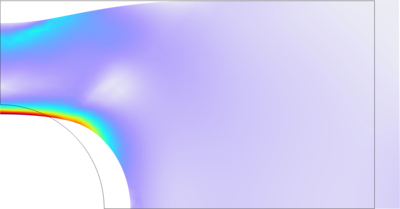
This example shows the analysis of a perforated plate loaded into the plastic regime. Part of the example is a benchmark, which you can find in section 7.10 of The Finite Element Method by O.C. Zienkiewicz. The unloading of the plate and residual stresses are also studied. In a second ... Per saperne di più

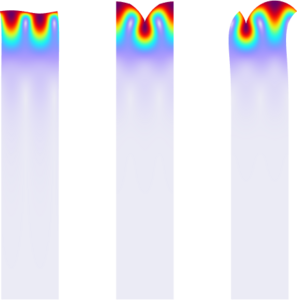
In this example, wrinkling is studied in a cylindrical membrane of nonuniform thickness under axial and pressure loading. The membrane is modeled as an incompressible Mooney–Rivlin material. During axial stretching, certain portions of the membrane undergo wrinkling; however, the ... Per saperne di più
FEM simulation can be used to obtain a SAW velocity and some related parameters (squared electromechanical coupling coefficient, reflectivity, etc.) for different typical configurations. Such parameters are input data for various analytical and semi-analytical methods of SAW device ... Per saperne di più

The electron energy distribution function (EEDF) plays an important role in the overall behavior of discharges. In this example, the formation period of an Argon plasma is studied with special attention paid to the EEDF. The plasma is created within a 4 cm gap by a DC source voltage of 1 ... Per saperne di più
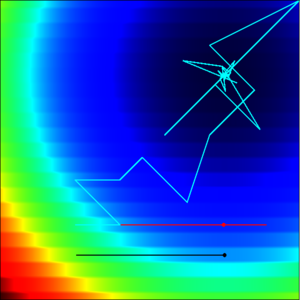
The App solves various 2D benchmark problems illustrating the pros and cons of the optimization solvers. Per saperne di più
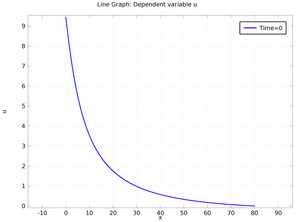
The Black-Scholes equation, computes the value u of a European stock option. Black-Scholes derived an analytical expression for the solution to this problem. However, the formula works only for certain cases; for instance, you cannot employ it when sigma and r are functions of x and t. ... Per saperne di più

This example illustrates the use of the Maxwell-Stefan diffusion model available with the Transport of Concentrated Species interface. It models multicomponent gas-phase diffusion in a Stefan tube in 1D. In this case, it is a liquid mixture of acetone and methanol that evaporates into ... Per saperne di più


