
La Galleria delle Applicazioni raccoglie un'ampia varietà di tutorial e di app dimostrative realizzati con COMSOL Multiphysics in diversi ambiti applicativi, inclusi quelli elettrico, meccanico, fluidico e chimico. E' possibile scaricare i file dei modelli e delle app demo pronti all'uso e le istruzioni step-by-step per costruirli, e utilizzarli come punto di partenza per le proprie simulazioni.
Lo strumento di Ricerca Rapida permette di trovare i modelli che si riferiscono alla propria area di interesse.
Si noti che molti degli esempi qui presentati sono accessibili anche tramite le Librerie delle Applicazioni incorporate nel software COMSOL Multiphysics® e disponibili dal menu File.
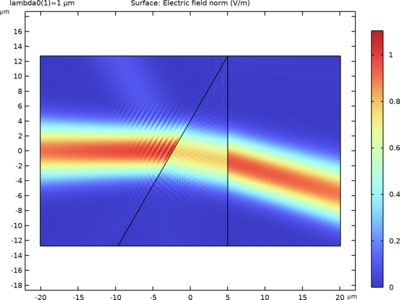
This model illustrates the refraction of light while passing through an optical prism using s– and p–polarized incident Gaussian beams. The prism boundaries are coated with anti–reflection coatings. It also calculates the reflectance and transmittance to analyze the performance of anti ... Per saperne di più
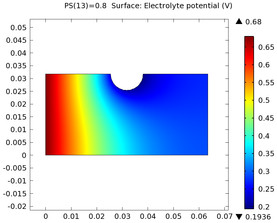
This example models cathodic protection of a steel reinforcing bar in concrete. Three different electrochemical reactions are considered on the steel surface. Charge and oxygen transport are modeled in the concrete domain, where the electrolyte conductivity and oxygen diffusivity depend ... Per saperne di più
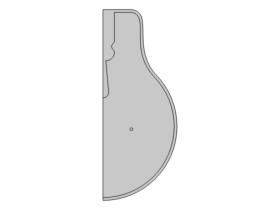
This tutorial introduces a workflow typical of creating geometry for simulation by using Sketch mode to draw complex shapes. Follow the step-by-step instructions to draw the geometry for the analysis of a light bulb. The physics setup is described in the model Free Convection in a Light ... Per saperne di più
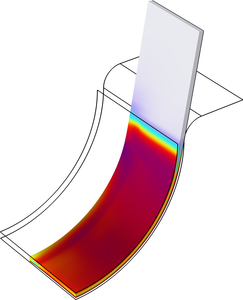
This example benchmarks a NAFEMS validation model of a friction contact problem with an elastoplastic material model. A thin metal sheet is forced into a die by a punch. Both the compressing displacement and the release of the punch are modeled in order to compute the forming angle (at ... Per saperne di più
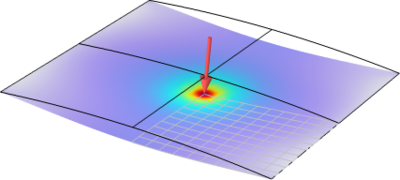
For slender structures, buckling can be a catastrophic instability if the service load exceeds the critical buckling load. For such structures, it can be important to study the structural behavior beyond the critical buckling load. Such a study is known as a postbuckling analysis. ... Per saperne di più
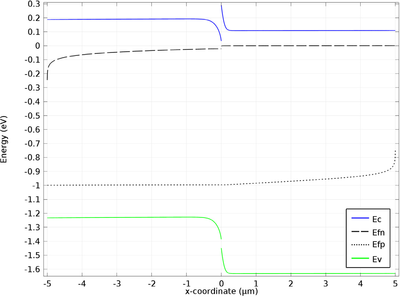
This benchmark model simulates three different heterojunction configurations under forward and reverse bias. It shows the difference in using the continuous quasi-Fermi level formulation versus the thermionic emission formulation for the charge transfer across the heterojunction. The ... Per saperne di più
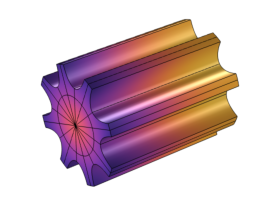
This example reproduces parts of the study of Ref. 1 on the thermal contact resistance at the interface between a heat sink and an electronic package. Eight cooling fins equip the cylindrical heat sink and contact is made at the radial boundaries of the package. The efficiency of the ... Per saperne di più
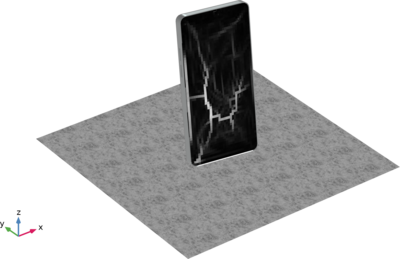
Drop tests are used to evaluate how consumer products respond to impacts and high accelerations. In this example, the Solid Mechanics, Explicit Dynamics interface is used to numerically simulate a drop test of a mobile phone, highlighting the permanent deformation of the aluminum case ... Per saperne di più


