
La Galleria delle Applicazioni raccoglie un'ampia varietà di tutorial e di app dimostrative realizzati con COMSOL Multiphysics in diversi ambiti applicativi, inclusi quelli elettrico, meccanico, fluidico e chimico. E' possibile scaricare i file dei modelli e delle app demo pronti all'uso e le istruzioni step-by-step per costruirli, e utilizzarli come punto di partenza per le proprie simulazioni.
Lo strumento di Ricerca Rapida permette di trovare i modelli che si riferiscono alla propria area di interesse.
Si noti che molti degli esempi qui presentati sono accessibili anche tramite le Librerie delle Applicazioni incorporate nel software COMSOL Multiphysics® e disponibili dal menu File.
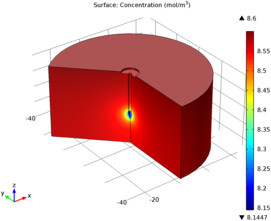
This tutorial example serves as an introduction to the Corrosion Module and models the metal oxidation and oxygen reduction current densities on the surface of a galvanized nail, surrounded by a piece of wet wood, which acts as electrolyte. The protecting zinc layer on the nail is not ... Per saperne di più
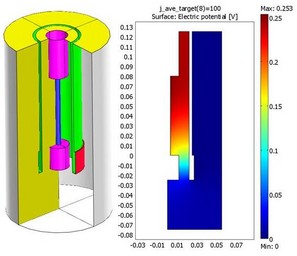
Rotating cylinder Hull cells are an important experimental tool in electroplating and electrodeposition and are used for the measurement of nonuniform current distribution, mass transport, and throwing power of plating baths. The model reproduces the results for a commercially available ... Per saperne di più
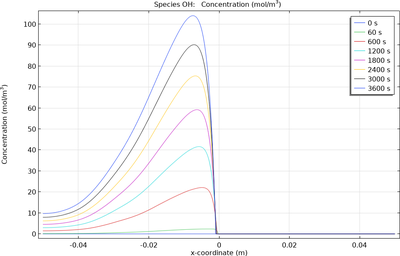
Atmospheric corrosion occurs when metallic structures are exposed to humid air forming a thin electrolyte film in the range of up to a few hundred micrometers. The model presented here accounts for charge transport as well mass transport involving 10 species and 6 homogeneous ... Per saperne di più
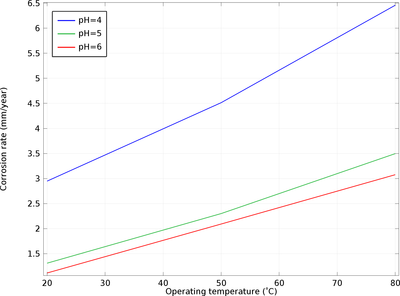
Carbon dioxide in aqueous solution is highly corrosive and can cause significant damage to steel designs. Such conditions arise in pipes used in a variety of applications, especially within the petrochemical industry. In this tutorial example, turbulent flows consisting of carbon ... Per saperne di più
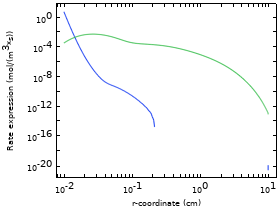
This tutorial presents a study of positive and negative corona discharges in dry air at atmospheric pressure. The discharges are sustained within two electrodes in a coaxial configuration by a high voltage DC source applied to the inner electrode. Two different types of models are used: ... Per saperne di più
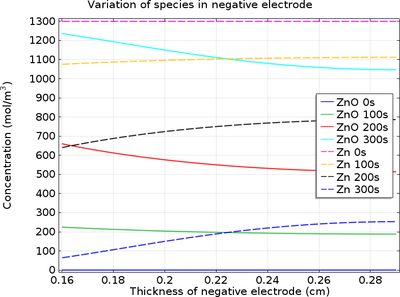
Zinc-Silver oxide (Zn-AgO) batteries are used in different industries due to their high capacity per unit weight. In this work, discharge of a Zn-AgO battery is simulated using the Battery with Binary Electrolyte interface. The electrochemical reactions in the positive and negative ... Per saperne di più

This model simulates atmospheric galvanic corrosion of a busbar, which includes a copper flange, an aluminum alloy flange in contact with a zinc nut and bolt. The Secondary Current Distribution interface is used to solve for the electric potential in electrode domain and Current ... Per saperne di più
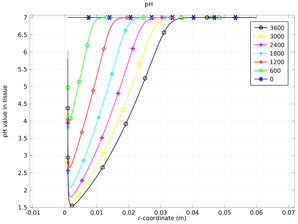
This model incorporates the transport and electrolytic reaction in the treatment of tumor tissue. Oxygen evolution at the anode produces protons, which lowers the pH, while chlorine production also leads to lowered pH through the hydrolysis of chlorine. One effect of a low pH is the ... Per saperne di più
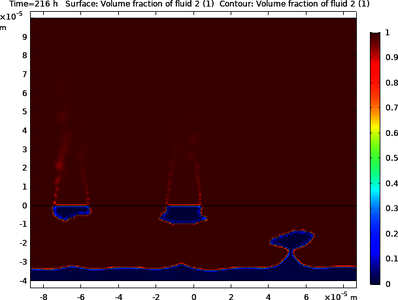
This example models galvanic corrosion between two different phases in a magnesium alloy for a representative cross-sectional microstructure configuration. The Phase Field interface is used here to model dissolution of a constituent phase leading to topological changes. The electrode ... Per saperne di più

This model defines a zero-gap alkaline water electrolyzer, where oxygen and hydrogen gas are evolved in porous gas diffusion nickel felt electrodes, placed adjacent to a porous separator (diaphragm). The geometry defines a unit cell of an electrolyzer stack, in turn comprising two full ... Per saperne di più


