
La Galleria delle Applicazioni raccoglie un'ampia varietà di tutorial e di app dimostrative realizzati con COMSOL Multiphysics in diversi ambiti applicativi, inclusi quelli elettrico, meccanico, fluidico e chimico. E' possibile scaricare i file dei modelli e delle app demo pronti all'uso e le istruzioni step-by-step per costruirli, e utilizzarli come punto di partenza per le proprie simulazioni.
Lo strumento di Ricerca Rapida permette di trovare i modelli che si riferiscono alla propria area di interesse.
Si noti che molti degli esempi qui presentati sono accessibili anche tramite le Librerie delle Applicazioni incorporate nel software COMSOL Multiphysics® e disponibili dal menu File.
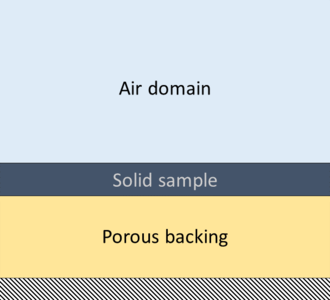
This app allows you to calculate the absorption coefficient and surface impedance of a sound absorbers for normal and random incidences. The computed quantities can be used when setting up boundary conditions in a Pressure Acoustics, Frequency Domain model or a Ray Acoustics model. The ... Per saperne di più
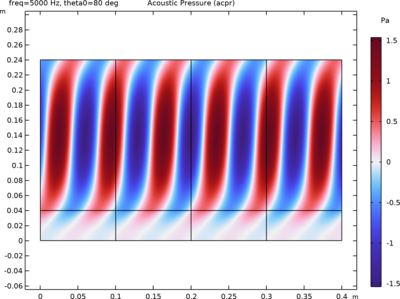
This is a 2D model of an anisotropic porous absorbing material. The absorption coefficient alpha are determined as functions of frequency for three different incidence angles. The example uses Periodic Floquet boundary conditions. The model uses two different methods for modeling the ... Per saperne di più
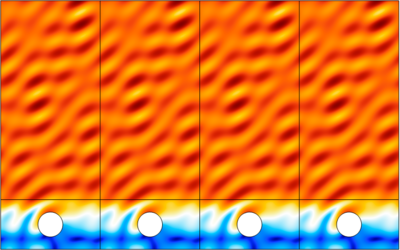
This is a model of acoustic absorption by a porous acoustic open cell foam. In porous materials the sound propagates in a network of small interconnected pores. Because the dimensions of the pores are small, losses occur due to thermal conduction and viscous friction. Acoustic foams are ... Per saperne di più
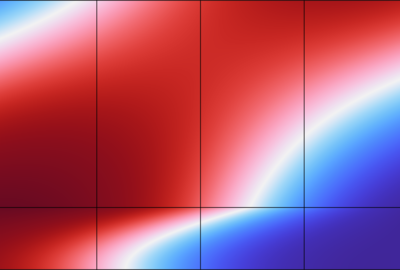
This tutorial investigates the acoustic properties of a porous layer made of glass wool. The porous material has transverse isotropic properties and is modeled with the full anisotropic poroelastic material model. Per saperne di più
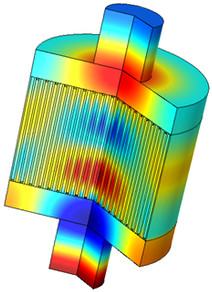
This is the model of the acoustics in a particulate-filter-like system. Real systems, like diesel particulate filters (DPFs), are designed to remove/filter soot (diesel particles) from the exhaust of diesel engine vehicles. The porous medium in such systems are typically structured with ... Per saperne di più
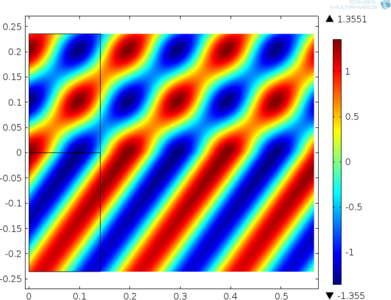
This model determines the reflection coefficient of plane acoustic waves, at different frequencies and at different angles of incidence, off a water-sediment interface. The ability of the Poroelasitc Waves interface to model the coupled acoustic and elastic wave in any porous substance ... Per saperne di più
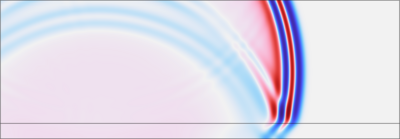
This tutorial studies the propagation of sound in the presence of a porous absorber in the time domain. It demonstrates how to model a porous absorber using the local and extended reacting approximations and compares the two approaches for absorbers of various thickness. The dissipative ... Per saperne di più
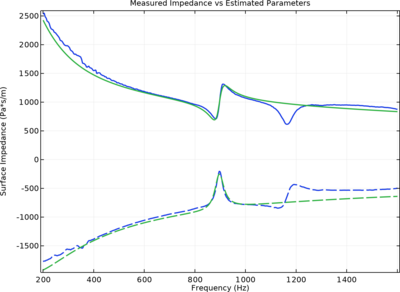
This app is an example of how the poroelastic properties of a porous material can be determined based on measurement done with an impedance tube and parameter estimation. Being able to determine the characteristics of a porous material from a single and simple measurement opens the door ... Per saperne di più

This example describes the pressure wave propagation in a muffler for an internal combustion engine. This example shows how to analyze both inductive and resistive damping in a muffler as well as the use of port boundary conditions. Per saperne di più
Headphones are closely coupled to the ear, and so it is not possible to measure their sensitivity in a classical acoustic free-field setup used for loudspeakers. The measurement requires the use of artificial heads and ears to accurately represent the usage conditions. This model shows ... Per saperne di più


