
La Galleria delle Applicazioni raccoglie un'ampia varietà di tutorial e di app dimostrative realizzati con COMSOL Multiphysics in diversi ambiti applicativi, inclusi quelli elettrico, meccanico, fluidico e chimico. E' possibile scaricare i file dei modelli e delle app demo pronti all'uso e le istruzioni step-by-step per costruirli, e utilizzarli come punto di partenza per le proprie simulazioni.
Lo strumento di Ricerca Rapida permette di trovare i modelli che si riferiscono alla propria area di interesse.
Si noti che molti degli esempi qui presentati sono accessibili anche tramite le Librerie delle Applicazioni incorporate nel software COMSOL Multiphysics® e disponibili dal menu File.
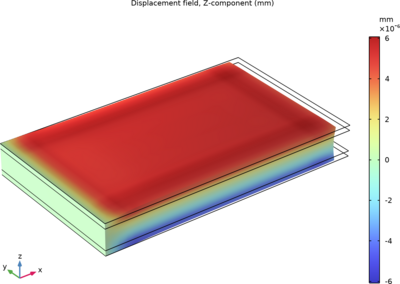
This tutorial is intended as a simple example showing how to model piezoelectric devices using the layered shell functionality. Two cases of material orientation are studied. In the first case, the pole axis is normal to the shell surface, which results in a thickness change. In the ... Per saperne di più

As integrated circuit (IC) technology advances, with circuits becoming more powerful and compact, it is increasingly important to identify and prevent any cause of circuit failure. One particularly critical factor contributing to circuit failure is electromigration within the ... Per saperne di più
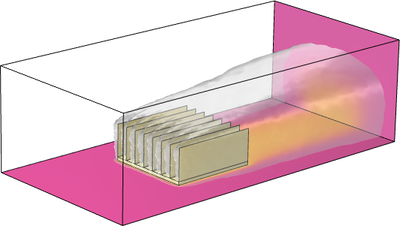
Thermoelectric elements are often used to cool or heat electronic components to a desired temperature. In such simulations, you are typically not interested in the behavior of the thermoelectric element itself but want to use its performance characteristics to model the overall response ... Per saperne di più
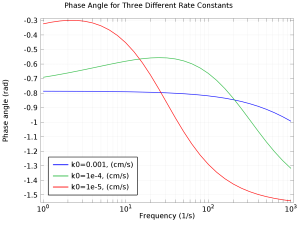
Electrochemical impedance spectroscopy (EIS) is a common technique in which a small oscillating perturbation is applied to an electrochemical system in order to investigate kinetic and transport properties. This example models EIS for a range of electrode reaction rates. Nyquist and Bode ... Per saperne di più
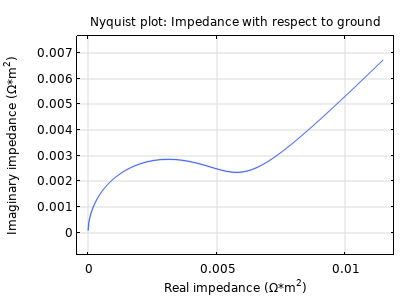
The purpose of this app is to understand EIS, Nyquist, and Bode plots. The app lets you vary the bulk concentration, diffusion coefficient, exchange current density, double layer capacitance, and the maximum and minimum frequency. Electrochemical impedance spectroscopy (EIS) is a common ... Per saperne di più
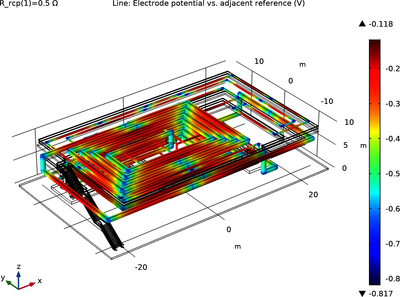
Highly alloyed stainless steel used in chlorinated seawater systems may be prone to corrosion under certain operating conditions. Conventional cathodic protection technique is less suitable for stainless steel due to unacceptable anode consumption rate and propensity to hydrogen ... Per saperne di più
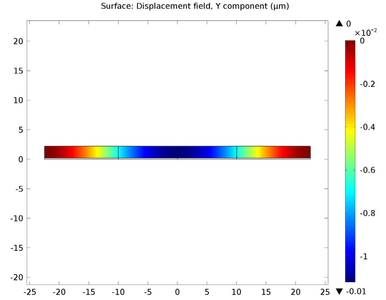
Silicon micromechanical resonators have long been used for designing sensors and are now becoming increasingly important as oscillators in the consumer electronics market. In this series of models, a surface micromachined MEMS resonator, designed as part of a micromechanical filter, is ... Per saperne di più
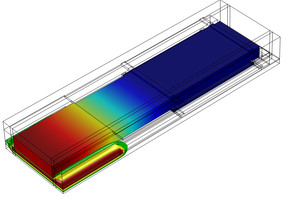
An electrostatically actuated MEMS resonator is simulated in the time and frequency domains. The device is driven by an AC + DC bias voltage applied across a parallel plate capacitor. The dependence of the resonant frequency on DC bias is assessed, and frequency domain and pull-in ... Per saperne di più
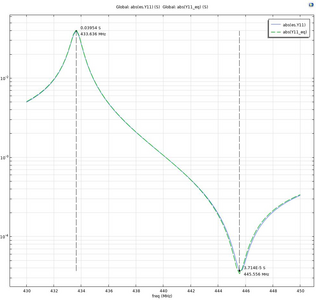
This model shows that the frequency response, i.e., admittance curve, of the SAW unit cell with IDT is in good agreement with the series resonance & antiresonance frequencies obtained from the eigenfrequency studies in the tutorial Surface Acoustic Wave Velocity Calculations from a ... Per saperne di più
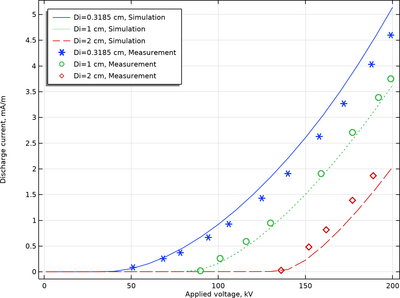
This model examines the behavior of a positive corona formed between concentric cylindrical conductors exposed to high applied voltages. The predicted current–voltage response closely matches the measurements. Rather than reproducing individual positive glow corona bursts, the setup ... Per saperne di più


