
Micromechanics and Macromechanics of a Composite Cylinder
Application ID: 67001
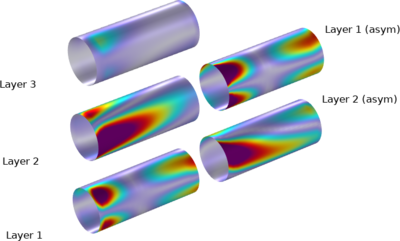
Fiber composites are widely used in industrial applications. Compared with traditional metallic engineering materials, fiber composites often offer higher specific stiffness and strength, as well as greater corrosion resistance. In addition, properties such as strength, stiffness, and toughness can often be tailored to specific applications. A fiber composite consists of load-carrying fibers embedded in a polymer resin. The composite material typically consists of a laminate of individual layers, with unidirectional fibers in each layer. This model demonstrates how to perform a stress analysis of a laminated composite cylinder.
Modeling the individual fibers in every layer of the laminate is computationally impractical. Instead, the model uses a simplified micromechanical model of a single carbon fiber embedded in epoxy to estimate the homogenized elastic properties of a single layer. It then uses these properties in the macromechanical model of the laminated composite cylinder. The laminate is modeled using two approaches: Layerwise (LW) theory and Equivalent Single Layer (ESL) theory.
This model example illustrates applications of this type that would nominally be built using the following products:
however, additional products may be required to completely define and model it. Furthermore, this example may also be defined and modeled using components from the following product combinations:
The combination of COMSOL® products required to model your application depends on several factors and may include boundary conditions, material properties, physics interfaces, and part libraries. Particular functionality may be common to several products. To determine the right combination of products for your modeling needs, review the Tabella delle Funzionalità and make use of a free evaluation license. The COMSOL Sales and Support teams are available for answering any questions you may have regarding this.


