

The energy was palpable at the 2026 Consumer Electronics Show (CES). More than 4100 exhibitors and 148,000 attendees from around the world flocked to the Las Vegas Convention Center in January of this year to see the latest in technology and innovation, hear from global leaders, and connect with industry partners. COMSOL joined in on the excitement as an exhibitor, alongside numerous cutting-edge technologies. Check out our recap of the event below!
The Future Is Here
CES offers inventors a stage to showcase the tech of the future, and this year, real-world applications of artificial intelligence (AI) emerged as the prevailing theme.
Throughout the 4-day event, it was clear to see that AI is expanding beyond chatbots to “physical AI”, often in the form of endearing, humanoid designs. According to a CES press release, these breakthroughs are turning AI into adaptable machines capable of delivering complex, real-world outcomes, evolving from simple task completion to more collaborative, analytical assistants. Autonomous robots could be spotted around the conference hall performing advanced tasks such as playing tennis, cooking customized meals, and deep-cleaning footwear. Additional exhibitions highlighted the use of robotics for home, industrial, medical, mobility, and supply chain applications.

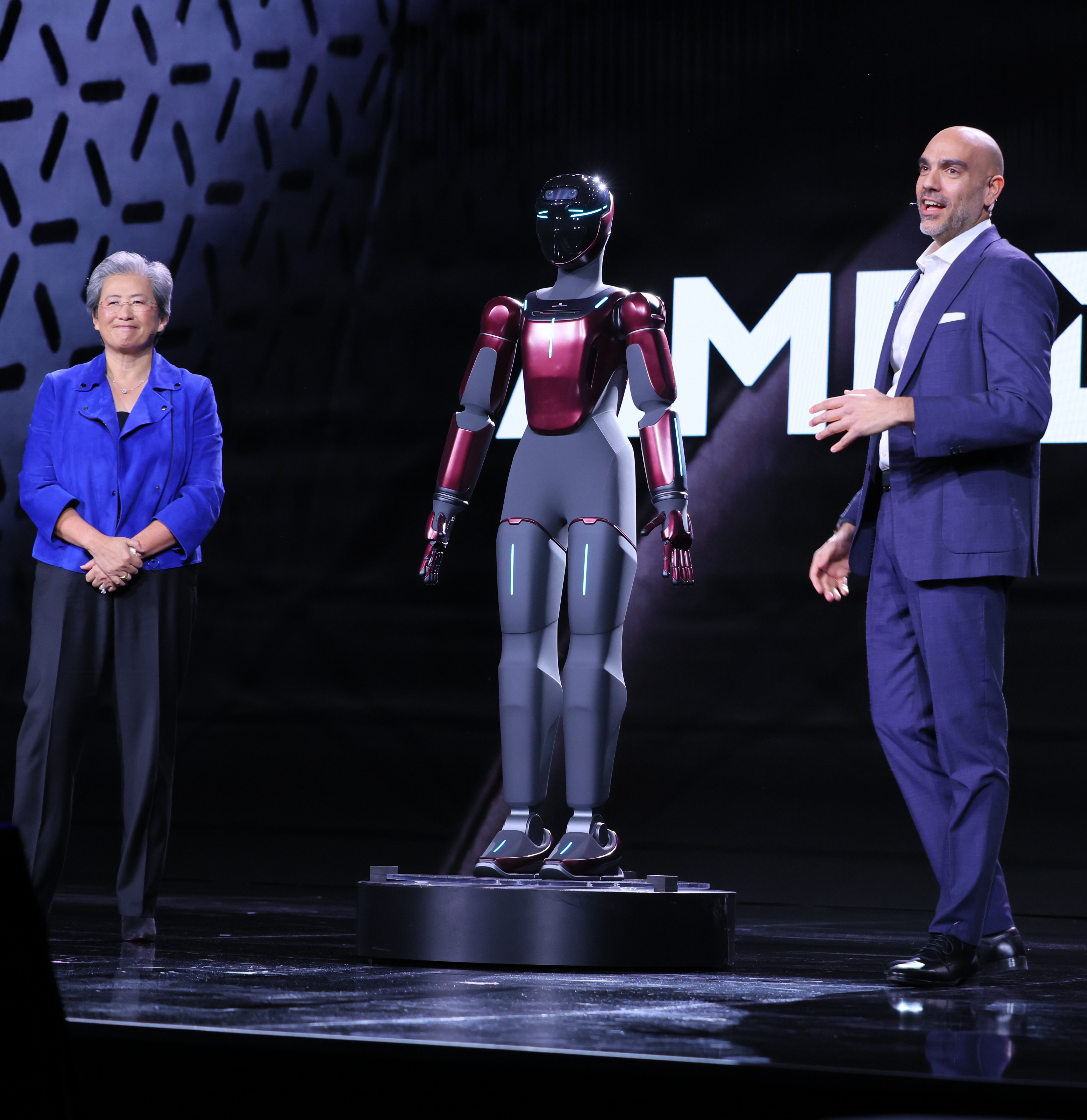
At left: CES 2026’s venue, the Las Vegas Convention Center. At right: Dr. Lisa Su of AMD and Daniele Pucci of Generative Bionics unveiled GENE.01 at CES, a robot that can not only execute instructions but also learn from physical experience and respond fluidly to changing conditions in industrial settings. Photo courtesy of the Consumer Technology Association®.
Accessibility technology proved to be another major theme at CES, with a focus on improving quality of life and removing everyday barriers. Wearable tech, like artificial reality glasses and smart watches and rings, provides consumers with advanced health metric tracking and personalized alerts. Smartphones can be integrated with features such as at-home hearing tests and object identification, while smart appliances and security systems in the home can help older adults age safely in place.
 Attendees take a photo with a product exhibited at CES. Photo courtesy of the Consumer Technology Association®.
In addition to AI and accessibility tech, exhibitors represented a range of industries, from streaming services to energy to construction. No matter the industry, they can all utilize the capabilities of COMSOL Multiphysics® — simulation software to optimize R&D and accelerate innovation.
In the Arena
The COMSOL booth provided access to cutting-edge simulation work from various industries, demo stations for trying out COMSOL Multiphysics®, and even fun giveaways (like playing cards and tote bags). When asked what draws attendees into the booth, Bjorn Sjodin, sr. vice president of product management at COMSOL, replied, “It could be as simple as they are looking for an easy-to-use simulation software like COMSOL Multiphysics®. Or it could be that they are currently using simulation, but they’re only doing single-physics simulation…and they are now looking into COMSOL Multiphysics® to incorporate additional physical phenomena to get a higher fidelity representation of their product or device.”
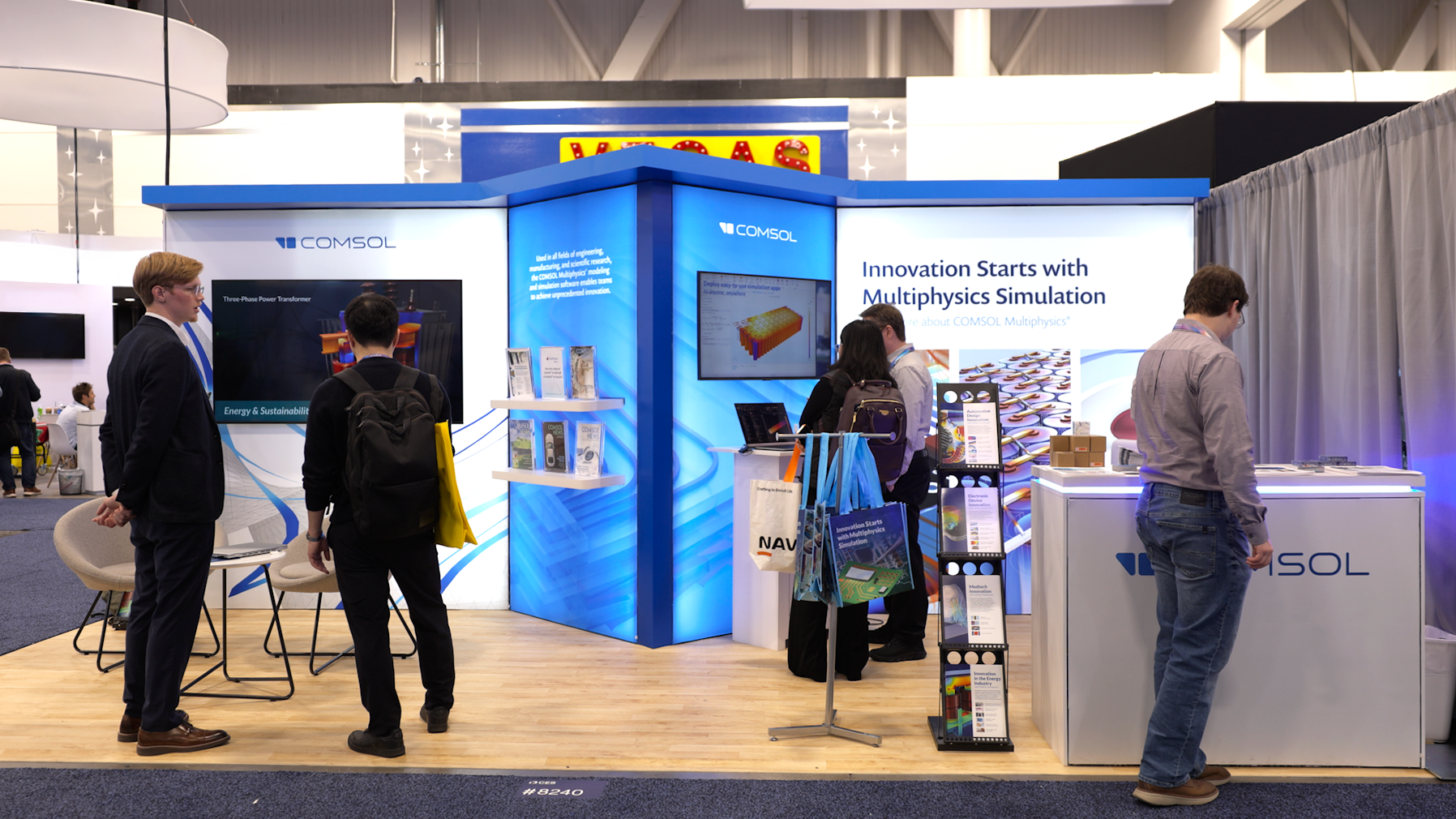 CES 2026 attendees explore the many use cases of modeling and simulation at the COMSOL booth.
There were also many conversations at the booth about the use of simulation in battery design, reflecting on the rapid expansion of electrification beyond electric vehicles and into electric aviation, boats, and other varieties of novel applications. “Batteries are multiphysics by nature,” said Niloofar Kamyab, product management lead of electrochemical engineering at COMSOL. Revolutionizing these applications with battery power requires rethinking design metrics such as performance, battery life, and safety analysis. “Having an optimal design requires a long experimentation and iteration process,” she explained. “That’s where simulation comes into play. Engineers can use multiphysics simulation not only to understand these multiphysics aspects but also to achieve an optimized and safe design.”
 Building multiphysics models of batteries across scales provides insight into how batteries perform under various conditions as well as their thermal characteristics, which helps engineers develop the optimal EV battery designs. Image courtesy: COMSOL.
With more than 55,000 international attendees, CES also offered a unique opportunity to connect with COMSOL’s global user base. “It was exciting to connect with professionals from a wide range of industries and backgrounds, all looking to understand how simulation can support their innovation efforts,” said Katherine Leiva, sales development representative at COMSOL.
We spoke to customers who were looking to expand the use of simulation to other departments in their organization. Simulation could optimize processes and accelerate development in areas such as manufacturing, production facilities, or on the factory floor, as well as even sales and marketing. “Two COMSOL Multiphysics® tools, the Application Builder and COMSOL Compiler™, allow simulation experts to create easy-to-use interfaces for non-simulation experts to use in other departments,” said Sjodin.
Learn more about the possibilities of simulation apps and how they can be brought into the field, factory, and lab.
Oscar Littmarck, vice president of marketing at COMSOL, also had several conversations with attendees about COMSOL Multiphysics® version 6.4. “At CES, we showcased some of the updates from our latest software release, such as GPU acceleration for all physics.” Version 6.4 introduced new capabilities for accelerating simulations using NVIDIA® GPUs, including NVIDIA cuDSS, NVIDIA’s CUDA® accelerated direct sparse solver. This solver performs matrix factorizations with one or more GPUs on a single computer, taking advantage of the high memory bandwidth and massive parallelism provided by recent GPU hardware. GPU support for NVIDIA CUDA® direct sparse solver (cuDSS) is fully integrated into the standard solver framework in 6.4, enabling users to take advantage of GPU acceleration for existing models without needing to make changes to the underlying physics settings.
 GPU acceleration with NVIDIA cuDSS also benefits conventional structural finite element analyses on standard workstation hardware. In this wheel rim example, the effective stress is visualized, and the GPU-based solve on an NVIDIA RTX™ 5000 Ada Generation workstation GPU achieved a 2× speedup compared with a CPU-based solve on an Intel® W5-2465X processor.
Learning from Leaders
CES featured a range of keynote talks from leaders and executives across a wide range of industries. Some highlights included a talk by the founder and CEO of NVIDIA, Jensen Huang. Huang shared the stage with Yuanqing Yang of Lenovo to discuss how AI is reshaping how we live, play, and work — sensing the 3D world, learning from data uniquely complex to the individual, and interacting with reality in ways we’ve never seen before as a “self-reinventing entity”. Other keynote speakers included Joe Creed of Caterpillar, who shared how the company is transitioning from a traditional equipment manufacturer to a high-tech innovator, and Dr. Lisa Su of AMD, who explored how much further AI will evolve and expand into our everyday lives. Other opportunities to hear from prominent speakers included a live podcast taping where Bob Sternfels of McKinsey and Hemant Taneja of General Catalyst explored how AI is reshaping strategy, investment, and innovation.
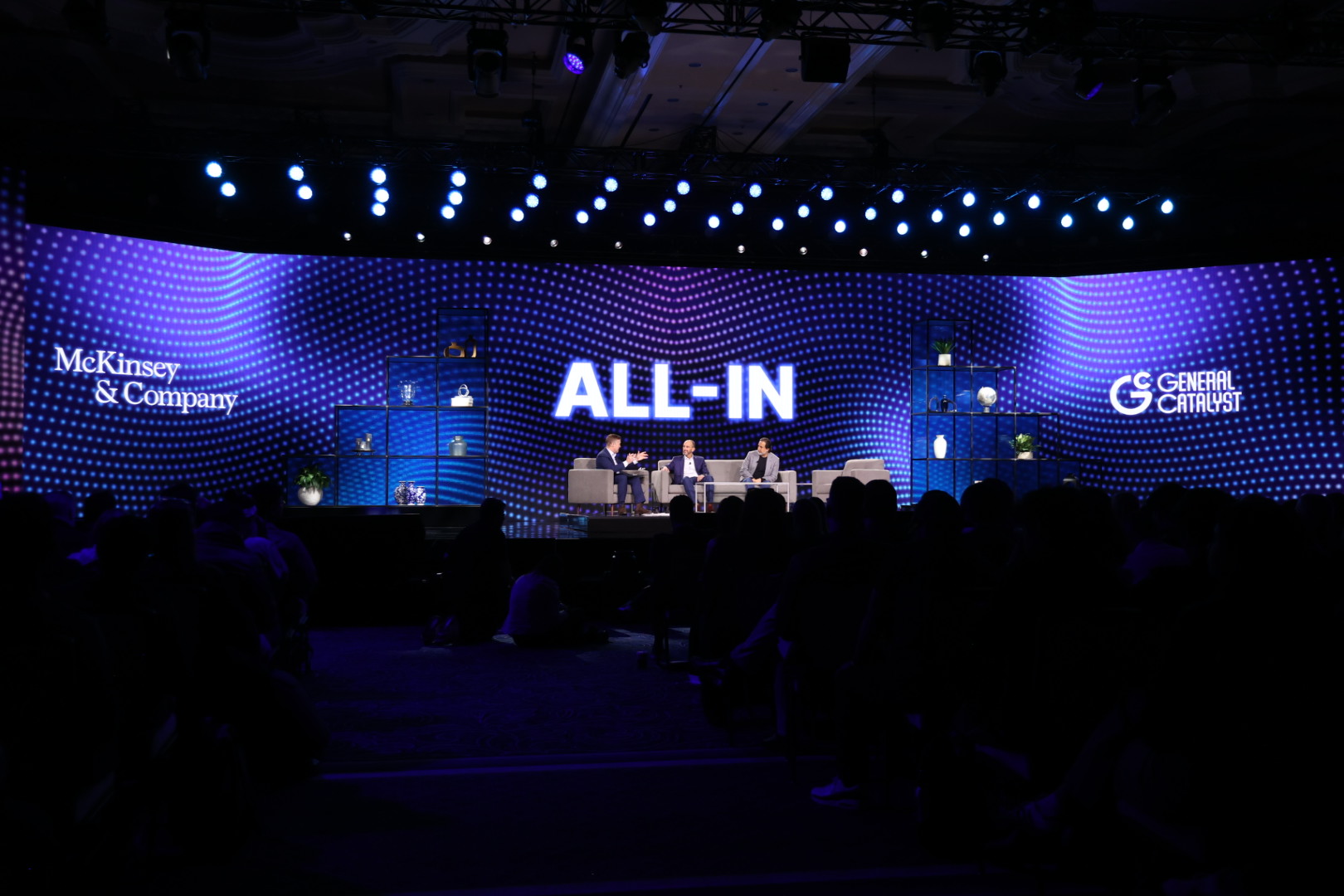 A live taping of the All-In podcast at CES. Photo courtesy of the Consumer Technology Association®.
We left the conference feeling inspired by the cutting-edge technology we witnessed, insights shared by industry leaders, and interesting conversations with attendees at our booth. Thank you to CES for hosting this dynamic event!
Looking Ahead
We have more exciting events lined up for the rest of 2026! Check out a few of our stops and be sure to swing by our booth:
Consumer Technology Association is a registered trademark of the Consumer Technology Association. Intel is a trademark of Intel Corporation in the U.S. and/or other countries. NVIDIA, CUDA, and RTX are trademarks and/or registered trademarks of NVIDIA Corporation in the U.S. and/or other countries.




Comments (0)