

Both luxury and standard automakers compete to attract customers with state-of-the-art features. Manufacturers often advertise top-notch sound and speaker systems and convenience features, such as parking sensors, to entice customers to choose the highest trim model. The COMSOL Multiphysics® software offers a way to help develop and optimize these features through acoustic ray tracing, which can be coupled with structural, electrical, pressure, or other multiphysics elements. In addition, COMSOL® supports GPU acceleration, rapidly increasing modeling efficiency.
Beep Beep! Look Out Behind You
The Ultrasonic Car Parking Sensor tutorial model computes the response of a sensor transducer, coupling multiphysics elements and multiple COMSOL Multiphysics® features. In the tutorial, you first solve a finite element model (FEM) to compute the spatial response of the parking sensor transducer. The FEM submodel, which includes piezoelectric materials, structures, and air, is used to create a detailed simulation of the ultrasonic transducer.
The radiation pattern of the transducer (its source characteristics) is used as a source to then model the ray release for a given parking scenario. The FEM-to-Ray-Tracing coupling can be set up using the Release from Exterior Field Calculation feature that’s built into the Ray Acoustics interface. The multiphysics model of the parking sensor couples the Solid Mechanics, Electrostatics, and Pressure Acoustics interfaces.
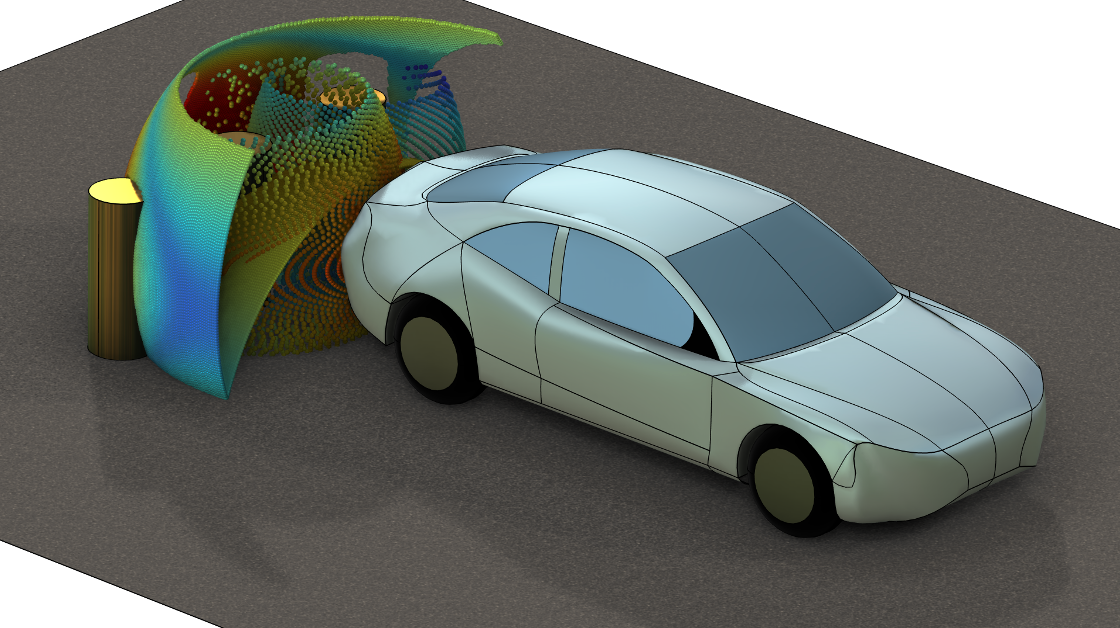 New cars are built with varying levels of sensors to alert drivers to objects behind them.
In the model, rays are transmitted from four receivers on the back of the car to detect an object or surface behind it. The model computes the response signal from the receivers when the car has one meter of space before it hits the obstacle. The distance and configuration can be changed to test different parking scenarios. In the first figure, the sensor analyzes ray paths of all simulated connecting source and receiving sensors. In the second, the color table visualizes the ray power (the acoustic level) when the sound has propagated some distance from the transducer. Red denotes high power.

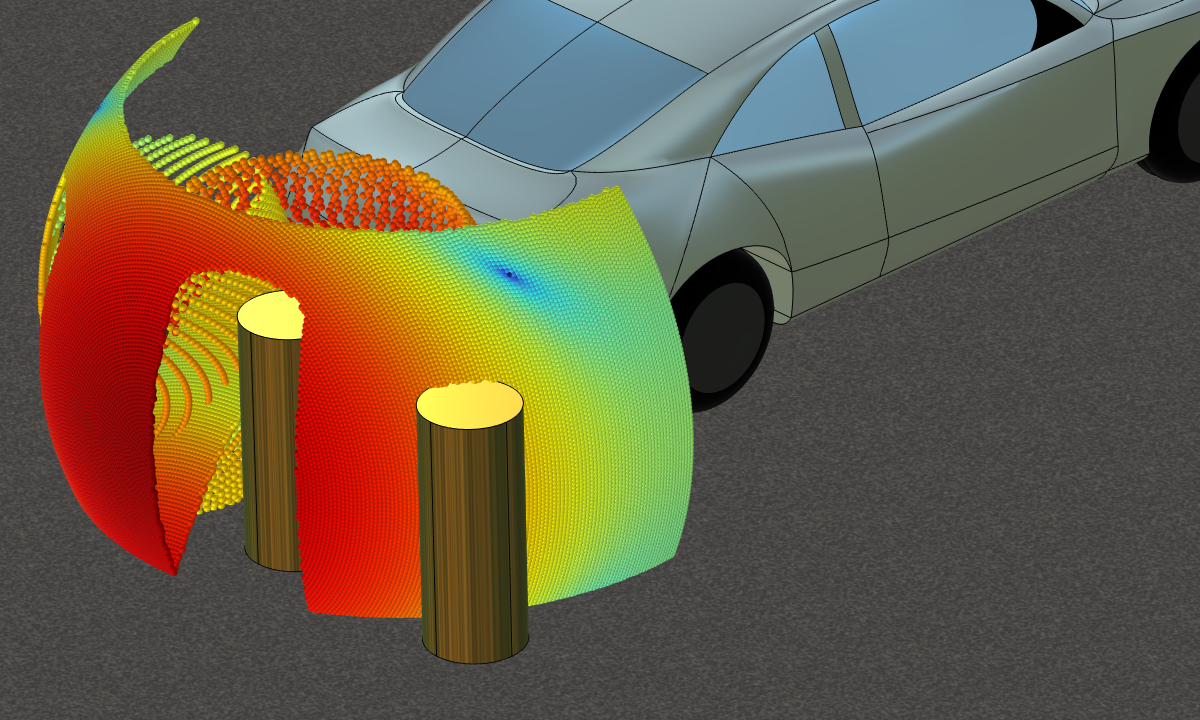
Rays that connect the source and the receivers, left, and the ray path of all simulated rays, right.
Four Receivers Working Together
The overall received signals can be reconstructed manually by convolving the input signal with the discrete impulse response. The data collected from each individual receiver make up the full detection of the sensor altogether. Tables 1–4 are included in the tutorial model documentation and correspond to Receivers 1, 2, 3, and 4.
 The data from tables 1 to 4 in the model documentation is used to reconstruct the received signals.
Hybrid Approach for Optimal Results in Cabin Acoustics
Car cabin acoustics are another important design feature under the umbrella of automotive acoustics. The Car Cabin Acoustics Using Hybrid FEM-Ray Source Coupling tutorial model demonstrates modeling car cabin acoustics using a hybrid FEM–ray tracing approach. In the cabin geometry, the sound is emitted from a tweeter in the dashboard of the car near the windshield. The speakers in this example are not modeled in full detail and are instead represented by Thiele–Small parameters and coupled to the acoustic domain using the Lumped Speaker Boundary condition. The rest of the car model features the standard sedan interior: leather seats, carpet, roof trim, and hard surfaces. These features are modeled with absorption coefficients, surface impedance, and material models.
This model uses a FEM-based submodel of the speaker and its immediate surroundings to solve a realistic near-field source for the ray propagation. The FEM and ray tracing coupling is done on a surface using the Release from Pressure Field feature, which takes the spatial distribution of power and the intensity vector into account. This differs from the “classical” hybrid method, where the low-frequency FEM solution is concatenated to the high-frequency ray solution. In this example, the two methods are combined for a detailed source description. In the tutorial, the method compares to both a full FEM simulation and a pure ray tracing model.
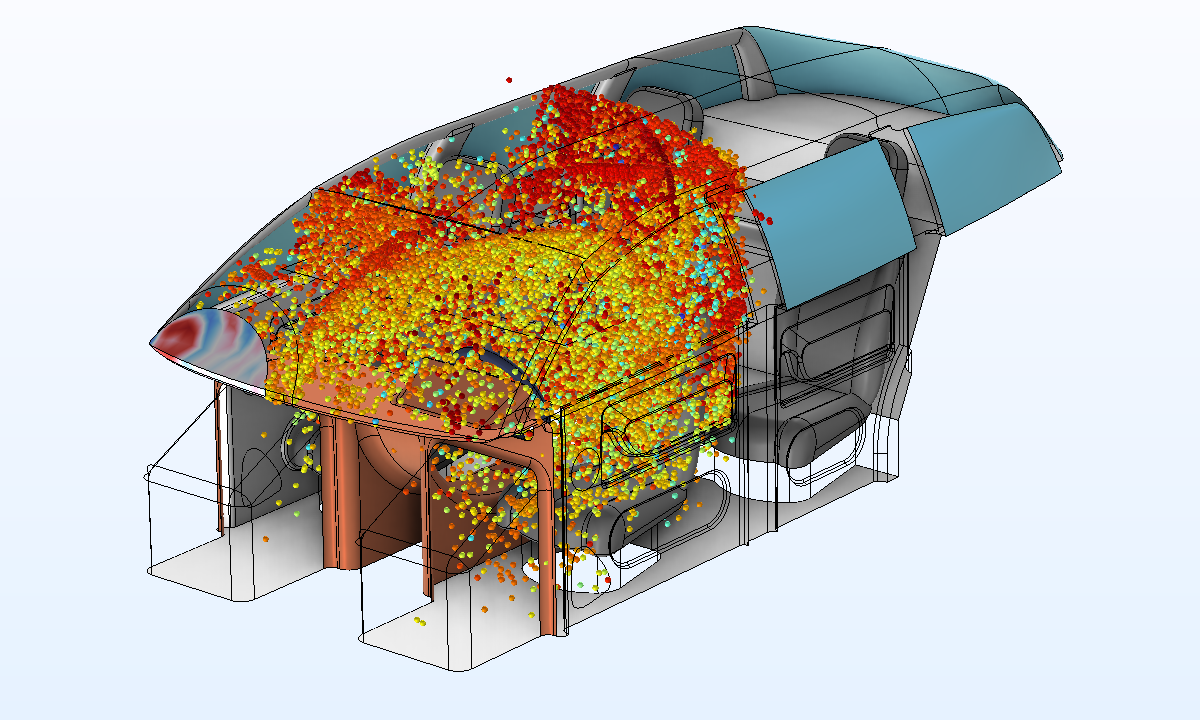 A tweeter located on the dashboard sends sound waves throughout the car cabin interior.
Simulation of the full cabin can also be performed with a full wave-based approach (leaving out the assumptions made in ray tracing). Such simulations can be performed in either the frequency domain, as shown in the Car Cabin Acoustics — Frequency-Domain Analysis tutorial model, or in the time domain, as shown in the Car Cabin Acoustics — Transient Analysis tutorial model. We will look further at the latter model below, in the context of accelerated simulations with GPU.
In the frequency domain model, the speakers are again modeled by the Lumped Speaker boundary condition, which represents the speakers as an electrical equivalent circuit with specified Thiele–Small parameters. The frequency-domain model demonstrates how different solver strategies can be used to solve the model when increasing the frequency. As the frequency increases, the wavelength becomes smaller, and a more refined computational mesh is required. COMSOL Multiphysics® includes several iterative methods. In the limit of very large models, a tailored solver can be set up as demonstrated in the Car Cabin Acoustics — Iterative Solver Suggestion for Cubic Elements tutorial model.
Coupling FEM with Ray Tracing for Detailed Source Modes
As mentioned above, in the Car Cabin Acoustics Using Hybrid FEM-Ray Source Coupling tutorial model, the ray tracing component includes a local full-wave submodel, which uses the Pressure Acoustics and Frequency Domain features. This submodel couples with rays released on the surface of the car cabin using the Release from Pressure Field interface. The ray direction vector is automatically determined from the wave-based FEM solution. The directivity of the source will be correct and lead to more accurate predictions. The ray power is automatically given by distributing the total radiated power onto the rays, weighted with the local intensity.
Sources in cars (in this case, the tweeter in the dashboard) will not behave like classical point sources, such as in, e.g., concert halls. Wave phenomena occur when the sources interact with their environment, like the car cabin interior.
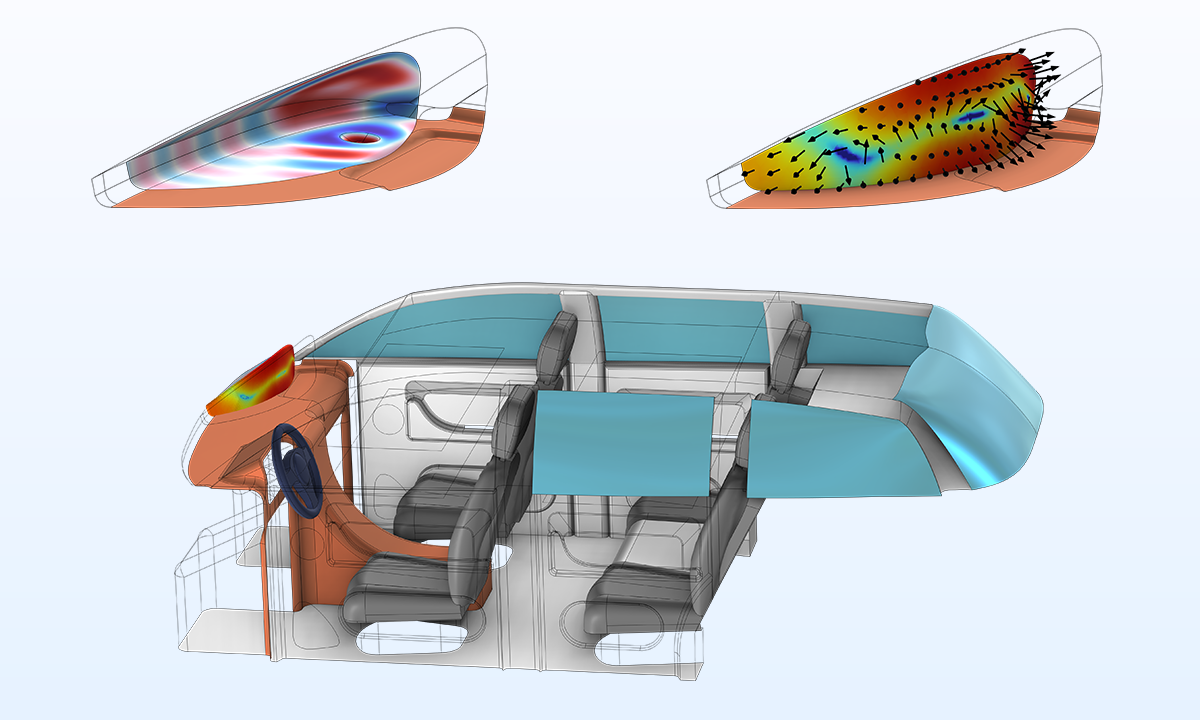
A local full-wave submodel is coupled with rays released using the Release from Pressure Field interface.
Concatenation of Solutions from Low- and High-Frequency Ranges
In order to get the full-range frequency response, or impulse response, the solution from the FEM model with low frequencies is combined with the solution from the ray tracing with high frequencies. This combination of solutions enables you to compute the broadband impulse response. The hybrid approach with concatenation is exemplified in the Car Cabin Acoustics – Broadband Impulse Response tutorial model.

Hybrid low-frequency FEM and high-frequency ray tracing solutions are combined to obtain broadband impulse response.
Efficiency Increases
The GPU support offered in the Acoustics Module significantly increases efficiency by drastically reducing the time it takes to solve models. The Car Cabin Acoustics — Transient Analysis model showcases how to include frequency-dependent wall impedance data in the time domain. The cabin is excited with a Gaussian-modulated 1000-Hz pulse. It would take 19 hours to solve this model on two cluster nodes with two processes per node, solving for 30 periods with 49 million degrees of freedom (DOFs). Using the accelerated formulation on a GPU, it takes about 1.5 hours (results are hardware and problem specific). This is a 20–25 times speedup, greatly improving efficiency and saving time and resources.
Particle velocity distribution in a car cabin with a 1000-Hz Gaussia-modulated pulse.
As technology in cars continues to evolve, combining different methods like ray tracing and FEM will help engineers and developers continue to optimize ultrasonic parking sensors and car cabin sound systems.
Next Steps
- Try out the Ultrasonic Car Parking Sensor and Car Cabin Acoustics — Frequency-Domain Analysis tutorial models
- Try out the Car Cabin Acoustics Using Hybrid FEM-Ray Source Coupling tutorial model
- Learn more about the hybrid modeling approach discussed here in the Modeling Room Acoustics Using Hybrid Pressure Acoustics and Ray-Tracing Methods tutorial model
- Try the wave-based, time-domain approach with a GPU in the Car Cabin Acoustics — Transient Analysis tutorial model





Comments (0)