
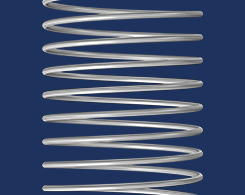
A Simulation App for Helical Spring Design and Analysis
Helical springs are found everywhere from medical devices to consumer and industrial products. Despite being commonplace for centuries, the design of a helical spring can be complex.
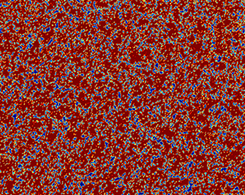
Material Characterization by Means of Simulation
Carbon-based materials, such as synthetic specialty graphites, are found in many industries, including solar, semiconductor, car manufacturing, ceramics, and metallurgy.
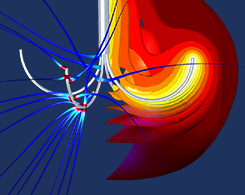
Predictive Analytics Capabilities of SmartUQ® for COMSOL®
How does COMSOL Multiphysics® fit into the predictive analytics and uncertainty quantification (UQ) workflow of SmartUQ®? Guest blogger Gavin Jones demonstrates with a microwave ablation example.

Modeling of NDT Methods Using COMSOL Multiphysics®
Active thermography, active ultrasonic, guided waves, acoustic emissions, and eddy current testing: 5 examples of how nondestructive testing (NDT) methods can benefit from multiphysics modeling.
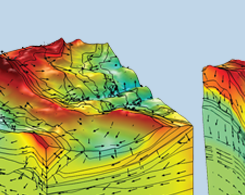
Integration of Geological Structures into Regional-Scale Groundwater Models
To study the dynamics of hydraulic processes at different scales, geotechnical researchers need to be able to integrate complex geological structures into their hydrogeological models.

How to Use the Platonic Solids as Geometry Parts in COMSOL®
The Platonic solids, named after Plato, are regular, convex polyhedra that consist of the tetrahedron, cube, octahedron, dodecahedron, and icosahedron.

Modeling Multi-Ply Materials with Composite Materials Technology
In a follow-up to a previous blog post on paper mechanics modeling, Eric Linvill of Lightness by Design compares 3 methods of analysis for multi-ply materials such as paperboard.
Hydrodynamic Thermal Transport in the Kinetic-Collective Model
F. Xavier Alvarez from the Universitat Autònoma de Barcelona (UAB) discusses using COMSOL Multiphysics® to model heat transfer at the nanoscale and better understand transport processes.


