
Ray Optics Blog Posts
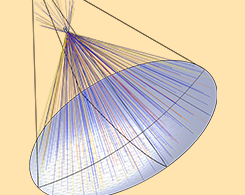
How to Model Solar Concentrators with the Ray Optics Module
Learn how to predict the concentration ratio for an idealized, parabolic solar reflector using Monte Carlo ray tracing in the Ray Optics Module, an add-on to COMSOL Multiphysics®.
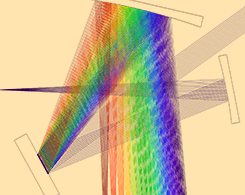
Using the New Ray Tracing Algorithm in COMSOL Multiphysics® 5.2a
The ability to trace rays in unmeshed domains, and even release and trace rays outside a geometry, has been available in the Ray Optics Module as of COMSOL Multiphysics® version 5.2a. Learn more.

Studying Laser-Material Interaction with Multiphysics Modeling
To mitigate damage to high-power laser systems, a research team from Lawrence Livermore National Laboratory used multiphysics simulation to investigate laser–material interactions.

Explaining the Pepper’s Ghost Illusion with Ray Optics
Pepper’s Ghost, the famous optical illusion used in theater and “hologram” concert performances, can be explained using ray optics. Learn more and see our homemade Pepper’s Ghost projector.
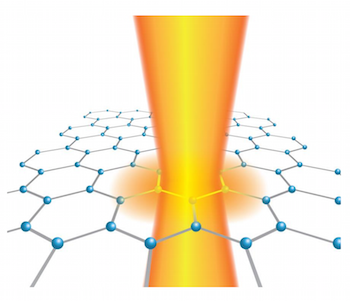
Should We Model Graphene as a 2D Sheet or Thin 3D Volume?
Graphene is a 2D sheet of carbon atoms that is 1 atomic layer thick. However, is graphene actually 2D or is it just incredibly thin, like a very fine piece of paper? How should it be modeled?
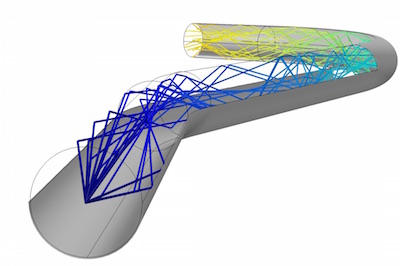
Simulating a Transparent Light Pipe to Optimize Transmittance
Transparent light pipes are used as an optimal source of natural light for underground areas, like subway stations, and areas without a lot of natural light, like prisons.
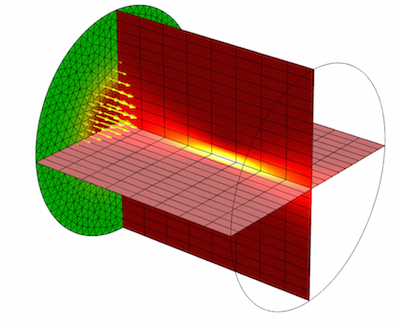
Modeling Laser-Material Interactions in COMSOL Multiphysics
When it comes to modeling laser-material interactions and heating, different modeling techniques are appropriate for different problems. We go over a few examples here >>

Modeling Thin Dielectric Films in Optics
Interested in modeling optical systems with dielectric films? Get an overview of some of the built-in tools in the Ray Optics Module for these modeling scenarios.
Ray Tracing in Monochromators and Spectrometers
Spectrometers are optical devices that measure some property of radiation as a function of its frequency, while monochromators transmit radiation of a specific frequency.
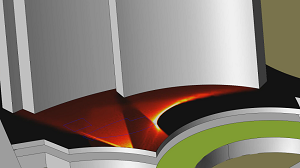
An Analysis of Caustic Surface Generation at the Vdara® Hotel
The Vdara® hotel on the Las Vegas strip has a unique crescent-shaped design that unfortunately contributed to the development of a caustic surface on the hotel’s pool deck.
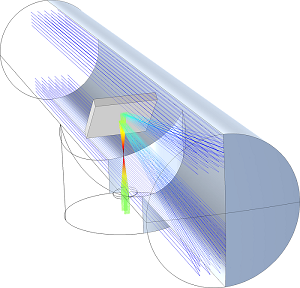
Modeling Ray Propagation in a Newtonian Telescope System
Ray optics trivia: The Newtonian telescope, recognized as the earliest operating reflecting telescope, was developed in 1668. Today, simulation can be used to trace rays through this device.
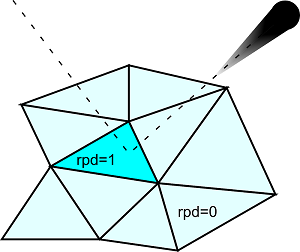
New Accumulators Boost Particle and Ray Tracing Functionality
Accumulators, a series of features available in the Particle Tracing Module, can be used to couple the results of a particle tracing simulation to other physics interfaces.
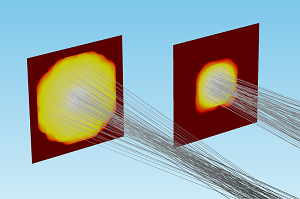
Modeling Thermally Induced Focal Shift in High-Powered Laser Systems
You can use the Ray Optics Module to create a fully self-consistent model of laser propagation that includes thermal and structural effects. Here, we take you through the process step by step.
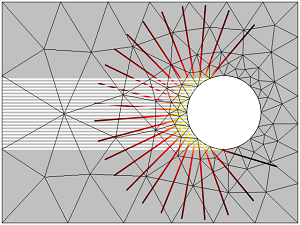
Introducing the Ray Optics Module
COMSOL Multiphysics version 5.0 introduced an add-on module for electromagnetics modeling: the Ray Optics Module. It can be used to perform ray tracing and geometrical optics studies.


