
In conformità con la nostra Quality Policy, COMSOL ha pubblicato una libreria con centinaia di esempi di modelli documentati che vengono regolarmente testati rispetto all'ultima versione del software COMSOL Multiphysics®, compresi i problemi di benchmark di ASME e NAFEMS, così come TEAM problems.
I nostri test di verifica e validazione (V&V) forniscono soluzioni sempre accurate che vengono confrontate con i risultati analitici e i dati di riferimento stabiliti. I modelli documentati qui sotto fanno parte delle Application Library integrate nel software COMSOL Multiphysics®. Includono inoltre valori di riferimento e fonti per un'ampia gamma di benchmark, così come istruzioni passo-passo per riprodurre i risultati sul proprio computer. Questi modelli possono essere usati non solo per documentare l'impegno nella garanzia di qualità del software (SQA) e nella verifica del codice numerico (NCV), ma anche come parte di un programma di formazione interno.
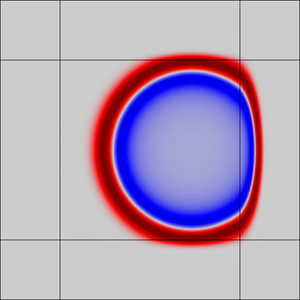
This tutorial simulates a standard test and benchmark model for nonreflecting conditions and sponge layers for linearized Euler-like systems. It involves the propagation of a transient Gaussian pulse in a 2D uniform flow. The Convected Wave Equation, Time Explicit interface solves the ... Per saperne di più

The capability to alter the polarization of light is crucial to a wide variety of optical devices. For example, the polarization of light has a significant effect on the performance of optical isolators, attenuators, and beam splitters. By assigning a specific polarization to light, most ... Per saperne di più
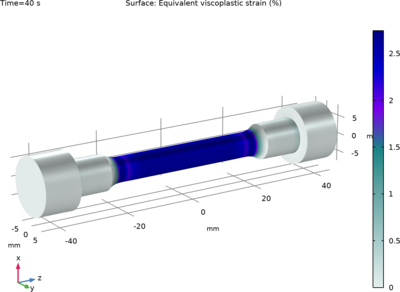
Most metals and alloys undergo viscoplastic deformation at high temperatures. In the case of cyclic loading, a constitutive law with both isotropic and kinematic hardening is necessary to describe effects such as ratcheting, cyclic softening/hardening, and stress relaxation. The ... Per saperne di più
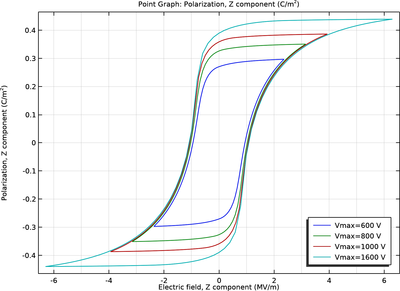
Ferroelectric materials exhibit nonlinear polarization behavior such as hysteresis and saturation at large applied electric fields. Many piezoelectric materials are ferroelectric. This model analyzes a simple actuator made of PZT piezoelectric ceramic material, which is subjected to ... Per saperne di più
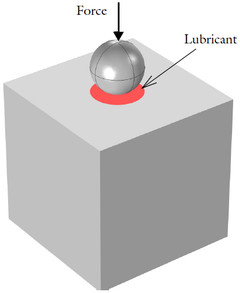
This benchmark model computes the transient pressure distribution and film height in a squeeze film bearing for lubrication in a nonconformal conjunction of a solid sphere and an elastic wall separated by a lubricant film. This model solves the benchmark case of hydrodynamic interaction ... Per saperne di più
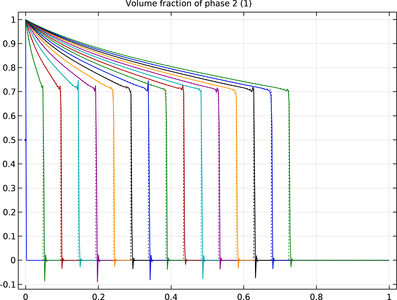
This benchmark models two-phase flow in a porous medium in 1D, where the flow can be analytically described by the Buckley-Leverett equation. Per saperne di più
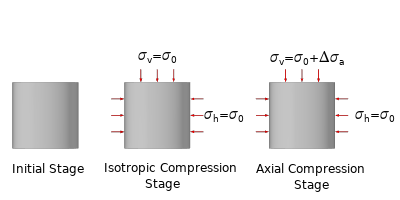
In this example, triaxial and oedometer tests are simulated using the Hardening Soil material model. Both tests exhibit a hyperbolic stress–strain relationship. For the triaxial test, it is confirmed that the axial stress approaches the analytical failure stress asymptotically. In the ... Per saperne di più
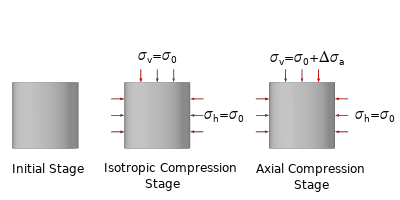
In this example, monotonic and cyclic triaxial tests are simulated using the Hardening Soil Small Strain material model. The model captures the effects of small strain stiffness and hysteresis under cyclic loading. The stress-strain relationship matches the hyperbolic curve reported in ... Per saperne di più
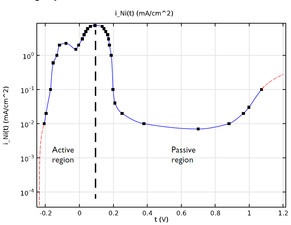
This model exemplifies the basic principles of crevice corrosion and how a time-dependent study can be used to simulate the electrode deformation. The model is in 2D and the polarization data for the corrosion reaction is taken from a paper by Absulsalam and others. The model and the ... Per saperne di più
This tutorial shows how to use the Surface-to-Surface Radiation interface to simulate radiative heat transfer with radiation between diffuse emitters and diffuse-and-specular reflectors. This model is separated in two parts. The first part focuses on a validation test for the radiative ... Per saperne di più


