
Defining Surface Plasmon Resonance Effects with Simulation
Sergei Yushanov, Jeffrey S. Crompton, Luke T. Gritter, and Kyle C. Koppenhoefer
AltaSim Technologies
Columbus, OH
USA
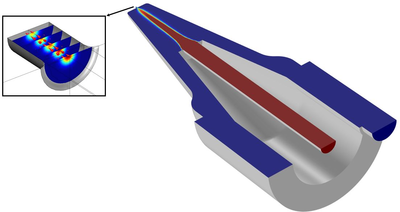
Surface Plasmon Resonance (SPR) is created by surface plasmons, coherent electron oscillations existing between any two materials where the real part of the dielectric function changes sign across the interface. SPR technology is based on the electromagnetic field component of incident light penetrating into a surface and it can be used to detect molecular adsorption on surfaces.
Plasmon excitation typically exists in two configurations: the Kretschmann-Raether configuration, where a thin metal film is sandwiched between a dielectric and air, and the incident wave is from the dielectric side; and the Otto configuration, where an air gap exists between the dielectric and the metal. Using COMSOL Multiphysics, the effect of the SPR on the electromagnetic field can be defined, which has allowed for the measurement of surface contaminants and nano-scale photonic devices.
Suggested Stories
Virtual Material Design in 3D Printing Makes Headway with Multiscale Modeling
The advantages of anisotropic properties in 3D printing materials have been difficult to exploit for product design, ...
Defying Convention to Achieve Faster Signal and Simulation Speeds
As the demand grows for faster electronic devices in smaller packages, we need to develop optimized high-speed ...
Getting Touchy-Feely with Touchscreen Design
We rely on capacitive touchscreens whenever we interact with a smartphone, MP3 device, or car video screen. ...
Optimizing Hematology Analysis: When Physical Prototypes Fail, Simulation Provides the Answers
Hematology analysis, the analysis of a blood sample to determine a variety of hematological parameters, is a major ...


