
Defining Surface Plasmon Resonance Effects with Simulation
Sergei Yushanov, Jeffrey S. Crompton, Luke T. Gritter, and Kyle C. Koppenhoefer
AltaSim Technologies
Columbus, OH
USA
Surface Plasmon Resonance (SPR) is created by surface plasmons, coherent electron oscillations existing between any two materials where the real part of the dielectric function changes sign across the interface. SPR technology is based on the electromagnetic field component of incident light penetrating into a surface and it can be used to detect molecular adsorption on surfaces.
Plasmon excitation typically exists in two configurations: the Kretschmann-Raether configuration, where a thin metal film is sandwiched between a dielectric and air, and the incident wave is from the dielectric side; and the Otto configuration, where an air gap exists between the dielectric and the metal. Using COMSOL Multiphysics, the effect of the SPR on the electromagnetic field can be defined, which has allowed for the measurement of surface contaminants and nano-scale photonic devices.
Suggested Stories
Designing Smart Solutions for Gas Flow Devices with Multiphysics Simulation
As India moves toward a reduced dependence on fossil fuels, researchers at Raychem RPG used multiphysics simulation to ...
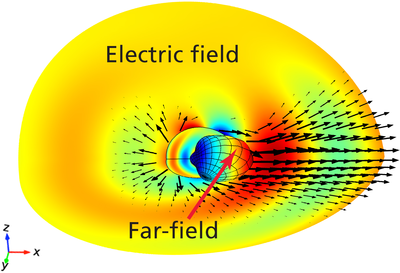
Scattering of Electromagnetic Waves by Particles
When electromagnetic waves propagate through matter, they interact with inhomogeneities and particles that can locally ...
Optimizing Fluid Sensors for Industrial Process Measurement
Endress+Hauser, a global leader in measurement instrumentation for industrial process engineering, is using ...
Making Predictions in Additive Manufacturing with Simulation Apps
Engineers at the Industrial Technology Research Institute (ITRI) can predict the performance of laser powder bed ...


