
Researchers in Germany Simulate Corrosion Protection for Submarines
David Schaefer
University of Duisburg-Essen, Duisburg, Germany
Germany's Technical Center for Ships and Naval Weapons, Bundeswehr, Germany
Submarines create underwater electric potential (UEP) signatures when using corrosion protection systems. These signatures are detectable by enemy vessels, an undesirable effect of the corrosion protection. Germany’s Technical Center for Ships and Naval Weapons (WTD 71) has worked with the Laboratory for General and Theoretical Electrical Engineering (ATE) at the University of Duisburg-Essen to research these UEP signatures in order to reduce them.
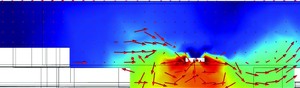
Using COMSOL, the team simulated the electric potential distribution on the hull of a submarine, indicating whether or not the material is protected from corrosion. The higher the electric potential, the more the hull is protected. After this, they modeled the signature left by the different electric potentials. The general notion was that a higher amount of corrosion leads to a more detectable signal, which is mostly true. Furthermore, the results showed that the signature is actually the least detectable between zero corrosion protection and the standard operating conditions for full corrosion protection.
Suggested Stories
Tiptoeing Through the Tulips to Protect Power Plants
ABB, a multinational leader in electrification products and power grid technology, develops generator circuit ...
Restoration of Lake Water Environments
Human activity steals oxygen from natural water sources such as lakes and this oxygen-deficient water often contains ...
Behind the Rumble and Roar of Mahindra Motorcycles
Optimization is a subtle and delicate art, especially when it comes to motorcycles. Regulatory requirements on pass-by ...
Keynote: Democratizing In Silico Ablation R&D via Simulation Apps
In this keynote talk from COMSOL Day: MedTech, Marcela Mercado Montoya of IN SILICO STEM introduces the capabilities ...


