
Ivana Milanovic, University of Hartford, USA
While covering the required fundamental material in undergraduate academic programs is the top priority, students require an extra set of knowledge and skills to flourish in the workforce. This is especially true in science, technology, engineering, and mathematics (STEM) fields, where there is rarely an abundance of time for inquiry-based learning and the development of field-specific skills. To address this issue, the University of Hartford integrated multiphysics modeling into their curricula. Using the Application Builder in the COMSOL Multiphysics® software, the university created simulation-based laboratory assignments through apps, which enhanced students’ physical intuition and their ability to visualize physical concepts.
Suggested Stories

Simulation-Led Strategy for Corrosion Prevention
Corrosion is a widespread concern costing the US billions of dollars annually. For the Navy, specifically, it is the ...
Making Biofuel a Cost-Effective, Renewable Source of Energy
Pyrolysis is a pre-commercial thermochemical process that converts renewable, plant-based materials such as wood into ...
Multiphysics Software Models Mean Flow-Augmented Acoustics in Rocket Systems
Historically, difficulties in modeling and predicting combustion instability have led engineers to costly physical ...
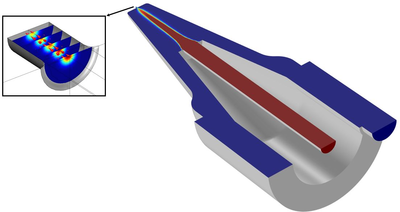
Optimizing Hematology Analysis: When Physical Prototypes Fail, Simulation Provides the Answers
Hematology analysis, the analysis of a blood sample to determine a variety of hematological parameters, is a major ...


