
Altran Designs Frequency Selective Surfaces with Simulation
F. De Vita, S. Di Marco, F. Costa and P. Turchi
Altran, Italy
Stealth airplanes and ships avoid radar detection by optimizing the shape of surfaces to reflect away from the radar source or absorb its energy. Yet, if a ship or aircraft’s antenna for communication purposes is to operate properly, it cannot be completely covered up. This makes it one of the remaining components with a large radar cross section and can essentially destroy the overall system’s invisibility to radar.
Altran, a global leader in innovation and high-tech engineering consulting, set out to design frequency selective surfaces with geometrical patterns that would optimize the stealth technology. The performance of a FSS is linked to its shape, thickness, choice of substrates and the phasing between individual elements. There are many possibilities, and testing each one physically would be time consuming for designers. Altran turned to simulation with COMSOL Multiphysics to investigate the frequency responses of a variety of shapes and sizes and how they are distributed on a surface in order to find promising candidates in just minutes.
Suggested Stories
Lighting the Way for Improved Synchrotron Vacuum Chambers at RadiaSoft
One of the goals of the Argonne National Laboratory (ANL) is to increase the brightness of synchrotron beams for the ...
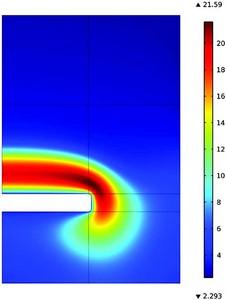
Capacitively Coupled Plasma Analysis
AltaSim Technologies provides engineering consulting services involving advanced multiphysics modeling such as ...
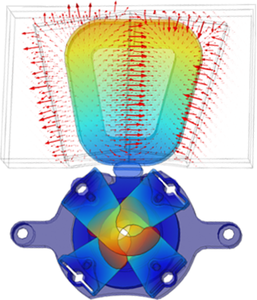
Keeping Cool: SRON Develops Thermal Calibration System for Deep-Space Telescope
Deep-space telescopes require ultrasensitive detectors and calibration to pick up weak far-infrared signals. The SpicA ...
Keynote: Automotive Audio in the Digital Age
The goal of audio systems is to recreate live sound as accurately as possible, no matter where they are being used. ...


