
I. Jain,
Tata Steel, India
Induction heating has become a valuable tool used by the steel industry for manufacturing various metal products. The process provides more precise heating control, uses less energy, and offers better quality assurance and reliability than traditional production processes.
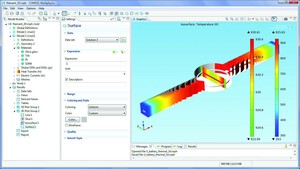
Tata Steel, one of the top ten steel companies worldwide, is using multiphysics simulation to analyze the electromagnetic, thermal, and metallurgic phenomena that occur during the manufacturing of many types of cables, wires, and ropes. Using COMSOL Multiphysics, Ishant Jain, Research and Design Engineer at Tata Steel, is simulating the heating process that takes place during the manufacturing of a wire strand to determine if the operating parameters currently used by the company are optimized to perform at their peak efficiency. Ultimately, the model will help to optimize the manufacturing process for a variety of different product types so that the desired mechanical properties for a particular application can be achieved.
Suggested Stories
Keynote: Modeling RF Heating of Hydrogen Plasmas for Nuclear Fusion
In nuclear fusion, the tokamak is the leading candidate for becoming a hydrogen fusion reactor, where the operating ...
Elevating the Performance of Ionization Gauges with Simulation
Semiconductor manufacturing and particle physics research depend on high-vacuum or ultra-high-vacuum (HV/UHV) ...
WiTricity Leverages Magnetic Resonance for Flexible Wireless Charging
Engineers at WiTricity have developed a flexible wireless charging setup that relies on magnetic resonance and can be ...
Optimization Slashes Energy Consumption in Silicon-Based MEMS CO2 Detectors
CEA-MINATEC is an international center for micro and nano-technologies which is funded by CEA, a French government ...


