
Knowles Uses Simulation to Optimize Hearing Aid Performance
Brenno Varanda, Knowles Corporation, Illinois, USA
Nearly 20% of the United States population has some degree of hearing impairment. Despite the relative inconspicuousness and perceived simplicity of hearing aids, their development involves complex, time-consuming, and computationally expensive research. The hearing aid industry is in dire need of a simplified model that can expedite the design process and provide options to consumers quicker. Engineers at Knowles Corporation have achieved this using COMSOL Multiphysics®. Employing a simplified “black box” circuitry model of a receiver coupled to a model of the vibroacoustic system, they drastically reduced the time it takes to optimize performance and bring a prototype to market.
Suggested Stories
Inspiring Young Engineers to Design for the Future at EPFL
EPFLoop, from the Swiss Federal Institute of Technology Lausanne (EPFL), designed their pod for the 2018 SpaceX ...
On the Cutting Edge of Hearing Aid Research
Nearly 20% of the United States population has some degree of hearing impairment. Despite the relative ...
Improving Gas Pipeline Squeeze-Off Standards with Numerical Simulation
Gas Technology Institute (GTI), a leader in natural gas research, development, and training, investigated industry ...
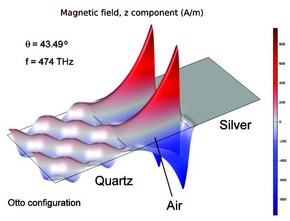
Surface Plasmon Resonance
Surface Plasmon Resonance (SPR) is created by surface plasmons, coherent electron oscillations existing between any ...


