
Using Simulation to Rapidly and Precisely Model Nanoresonators
J. Yang, M. Perrin, P. Lalanne
CNRS, France
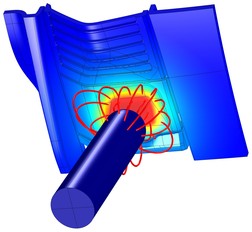
Nanoresonators, or optical nanoantennas, manage the concentration, radiation, and absorption of light at the nanometer scale and show stunning promise for future improvements to technology, such as sensors, computers, and other electronics. However, the ways that these devices scatter light and interact with their surrounding environment are not well understood, nor are the electromagnetic properties of the complex metal shapes that comprise them. Numerical approaches to calculating the resonance modes and excitations in nanoresonators have historically been cumbersome and error-prone.
Now, researchers and engineers at Institut d’Optique d’Aquitaine (Paris, France) are using COMSOL Multiphysics simulations to rapidly and precisely determine physical properties, calculate the resonance modes, and analyze the electromagnetic fields and scattering that occur due to excitation. They expect that their new approach to modeling these nanoresonators will lead to advancements in the development and use of nanoelectromechanical devices (NEMS) for a wide range of applications such as photovoltaics, spectroscopy, and improved electronic systems.
Suggested Stories
Increasing Productivity and Revenue with Computational Applications
HeatSinkSim is a simulation app created by the specialists at AltaSim Technologies that can help optimize heat sink ...
Keynote: Solving Problems in the Food Processing Industry with Multiphysics Models
At Conagra Brands, Soon Kiat Lau and his team use multiphysics simulation to solve common challenges in the food ...
Life Sciences Company Accelerates Biopharmaceutical R&D with a Dedicated CAE Department
Biopharmaceuticals are expensive to develop due to their complex molecular structure, the specialized manufacturing ...
Switching Made Easy
Modern cars offer a wide range of complex functionality that comes with several design challenges. This story ...


