
The Colorado School of Mines Uses Simulation to Track Fluid Movement
A. Haas, H. Mahardika, M. Karaoulis, and A. Revil
Colorado School of Mines, USA
Combining acoustic and electromagnetic analyses helps scientists to more efficiently measure and survey subterranean regions. Acoustic waves can travel long distances, but have limitations when it comes to providing details about formation properties, and cannot be used to identify the liquids flowing through them. Electromagnetic waves do not propagate as far as acoustic waves, but can identify and track the flow of pore water. Combining these methods makes the process easier in particular for scientists who track fracking fluids underground.
The Colorado School of Mines has created a system for locating fracking fluids by finding subsurface electromagnetic disturbances that occur based on the kinds of formations the water passes through. They wanted to simulate fracking events and produce synthetic seismograms and electrograms with the help of simulation. By linking COMSOL Multiphysics and MATLAB®, they designed a laboratory experiment in which they repeatedly hydraulically-fractured a porous cement cube by pumping in saline water under high pressure.
Suggested Stories
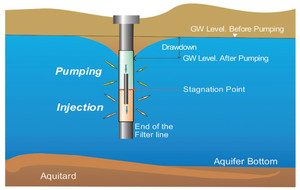
Pumping and Injecting from a Single Borehole
Professor Dr. Martin Sauter leads a group at the University of Göttingen in research on hydrogeology. Cooperating with ...
Designing a Miniaturized Wastewater Treatment Plant for Micropollutant Degradation
Eden Tech uses multiphysics simulation to design a miniaturized wastewater treatment system made from compact discs. ...
A Smooth Optical Surface in Minutes
Zeeko Ltd is a technology company that manufactures corrective polishing machines for optics and other surfaces. They ...
Meeting Quality Standards in Oil and Gas Extraction with Ultrasonic Transducers
Baker Hughes saves 30% on prototyping costs by using 3D ultrasonic simulations to optimize transducers used for ...


