
Monika Weber
Yale University
New Haven, CT
Professor Mark Reed and his team at Yale University are using COMSOL Multiphysics to develop a MEMS-based solution for detecting bacteria in blood. Called the α Screen, it will provide analyses speedily, accurately, and cost-effectively. Such a device would greatly help the food industry in improving meat quality and reducing the risk for infections. Current methods take too long for most food industries to use, as they need to deliver and sell food fresh, while newer alternatives are too expensive for routine use.
As a member of this leading nanotechnology group, Monika Weber used COMSOL Multiphysics to simulate aScreen and optimize its performance. This included modeling the microfluidics of the device and using particle tracing to track the potential routes taken by bacteria within the device.
With her model and presentation of the aScreen, Weber won the 2011 NASA Tech Briefs Create the Future Design Contest.
Suggested Stories
Researching a New Fuel for the HFIR: Advancements at ORNL Require Multiphysics Simulation to Support Safety and Reliability
In response to the increasing awareness of the risks associated with the proliferation of nuclear materials, the ...
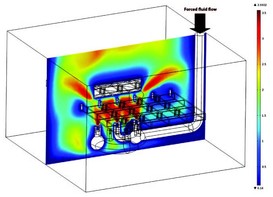
Conjugate Heat Transfer
This is an application brief describing the concept of Conjugate Heat Transfer, which is important in many industrial ...
Simulation Applications Streamline the Development of Electric Vehicle Motors
Engineers at Volkswagen Kassel build and distribute simulation applications that can be used to evaluate the strength ...
How Decaying Shells Help Preserve the Alkalinity of the Seas
Decaying seashells can release calcium carbonates, which help neutralize carbon dioxide in seawater. But ocean ...


