
M. Bachmann, V. Avilov, A. Gumenyuk, and M. Rethmeier
BAM Federal Institute For Materials Research and Testing
Germany
High-power laser beam welding uses a localized heat source to achieve narrow deep welds and high welding rates. Engineers run into some difficulties because the use of a localized heat source often results in the distortion of metal components; spattering and the ejection of droplets from the weld pool results in underfills, undercuts, craters, blowholes, or blowouts.
A stationary magnetic field is applied to the laser welding process to improve its quality and counteract effects such as spattering. BAM Federal Institute For Materials Research and Testing in Germany are working to improve the quality of high-power laser beam welding using COMSOL Multiphysics. To model and simulate the laser beam welding, heat transfer, fluid dynamics, and electromagnetics were coupled and solved. This allowed BAM to accurately model the process by including Marangoni effects, gravity, latent heats of fusion, and Lorentz forces.
Suggested Stories
Simulating Laser-Material Interactions
California-based Lawrence Livermore National Laboratory (LLNL) oversees the National Ignition Facility (NIF), which ...
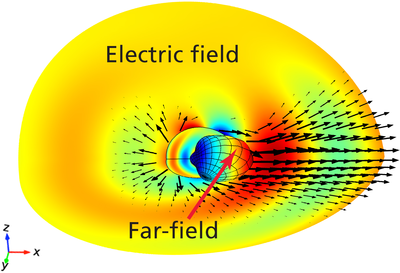
Scattering of Electromagnetic Waves by Particles
When electromagnetic waves propagate through matter, they interact with inhomogeneities and particles that can locally ...
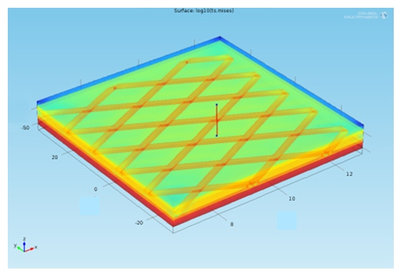
Boeing Simulates Thermal Expansion in Composites with Expanded Metal Foil for Lightning Protection of Aircraft Structures
Carbon fiber composites are used extensively throughout the body of modern aircraft, such as the Boeing 787 ...
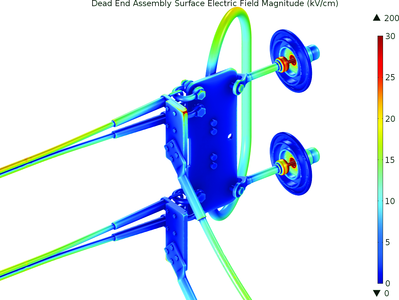
Enhancing Transmission Line Performance: Using Simulation to Optimize Design
Designing power transmission lines requires accounting for many factors: mechanical stress due to environmental ...


