
Konica Minolta Uses Simulation to Study and Optimize OLED Devices
Leiming Wang, Konica Minolta Laboratory, USA
As the demand for lightweight and flexible electronics continues to increase, so does the demand for lightweight and flexible light sources. Organic LEDs (OLEDs) have garnered tremendous interest because of their inherent elasticity, but suffer from a lack of brightness and efficiency. Researchers at Konica Minolta are working to alleviate these limitations and minimize light lost in their OLED designs. Using the COMSOL Multiphysics® software, they simulated the electromagnetic field and light emission distribution for a variety of nanostructured cathode geometries, determined the optimal configuration, and were able to cut light losses in half.
Suggested Stories
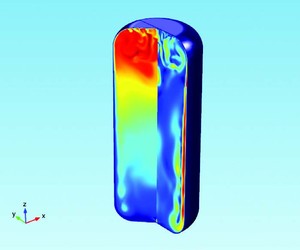
Modeling Helps Improve Safety in the Production of Teflon
BAM German Federal Institute for Materials Research & Testing in Berlin promotes industrial development by ...
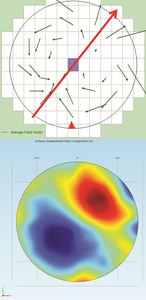
Modeling of Complex Physics Speeds Chip Development
With technological advancements accelerating so rapidly, more powerful computer chips are needed to meet the high ...
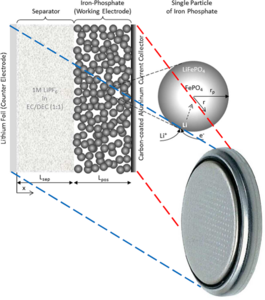
Highly Accurate Li-ion Battery Simulation
Battery management systems (BMSs) are designed to protect the batteries and predict their charge level. They use ...
Thermal Characterization of an Electronic Device with a Custom App
BE CAE & Test, a COMSOL Certified Consultant, created a thermal model of a surface-mount device for a client and ...


