
W. Lee, K. Jensen
MIT, MA, USA
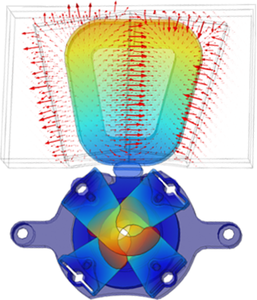
The chemical reactions used to generate solvents and certain pharmaceuticals rely on organic synthesis, a process of combining individual chemicals that can be accelerated through microwave heating. A microreactor system facilitates the direct, localized, and efficient temperature change necessary for successful synthesis. However, a uniform temperature distribution is crucial to the chemical process, and these reactions can be inhibited by unwanted temperature changes or heating that occurs too slowly. Wen-Hsuan Lee, a researcher at the Massachusetts Institute of Technology (MIT), fabricated a borosilicate glass microreactor to conduct this microwave organic synthesis, but when she tested her design in a microwave system, she discovered that the heating was uneven and below the desired temperature. Using COMSOL Multiphysics, she modeled the microreactor to investigate the effects of its geometry and orientation on the heating process. From her simulation results, she was able to redesign the microreactor and optimize its location and orientation in the microwave system to achieve successful organic synthesis.
Suggested Stories
Keynote: Automotive Audio in the Digital Age
The goal of audio systems is to recreate live sound as accurately as possible, no matter where they are being used. ...
Simulation Applications Help Shape the Design of Car Audio Systems
Audio entertainment systems for luxury cars must provide end users with the highest quality of in-car listening ...

Modeling the Electrochemistry of Blood Glucose Test Strips
Lifescan Scotland is a medical device company that designs and manufactures blood glucose monitoring kits for the ...
Keeping Cool: SRON Develops Thermal Calibration System for Deep-Space Telescope
Deep-space telescopes require ultrasensitive detectors and calibration to pick up weak far-infrared signals. The SpicA ...


