
W. Lee, K. Jensen
MIT, MA, USA
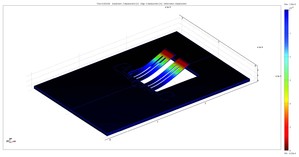
The chemical reactions used to generate solvents and certain pharmaceuticals rely on organic synthesis, a process of combining individual chemicals that can be accelerated through microwave heating. A microreactor system facilitates the direct, localized, and efficient temperature change necessary for successful synthesis. However, a uniform temperature distribution is crucial to the chemical process, and these reactions can be inhibited by unwanted temperature changes or heating that occurs too slowly. Wen-Hsuan Lee, a researcher at the Massachusetts Institute of Technology (MIT), fabricated a borosilicate glass microreactor to conduct this microwave organic synthesis, but when she tested her design in a microwave system, she discovered that the heating was uneven and below the desired temperature. Using COMSOL Multiphysics, she modeled the microreactor to investigate the effects of its geometry and orientation on the heating process. From her simulation results, she was able to redesign the microreactor and optimize its location and orientation in the microwave system to achieve successful organic synthesis.
Suggested Stories
Virtual Material Design in 3D Printing Makes Headway with Multiscale Modeling
The advantages of anisotropic properties in 3D printing materials have been difficult to exploit for product design, ...
Easy and Accurate Measurement of Blood Viscosity
Microvisk Technologies develops and manufactures devices for measuring blood viscosity using the power of Micro ...
Seeking Out Electrical Arcing Regions in Satellite Systems
Space is the epitome of an unpredictable and harsh environment. These conditions are near impossible to replicate via ...
3D Modeling of Armor Losses in High-Voltage Cables
NKT HV Cables used numerical modeling to investigate electromagnetic fields and calculate armor losses in 3D cable ...


