Scopri come la simulazione multifisica viene utilizzata in tutto il mondo per ricerca e sviluppo
La modellazione e simulazione multifisica favorisce l’innovazione in numerosi settori industriali e nel mondo accademico, come dimostrano le molteplici applicazioni illustrate negli articoli tecnici e nei poster presentati ogni anno da ingegneri, ricercatori e scienziati alla COMSOL Conference.
Lasciati ispirare dai recenti contributi raccolti qui sotto oppure, per trovare una presentazione specifica o filtrare i risultati per area di applicazione, anno o sede della conferenza, utilizza lo strumento di Ricerca Rapida.
Visualizza gli articoli presentati alla COMSOL Conference 2026

Oak Ridge National Laboratory’s High Flux Isotope Reactor (HFIR) is the highest flux reactor-based source of neutrons for research in the United States. Thermal and cold neutrons produced by HFIR are used to study physics, chemistry, material science, engineering, and biology. Currently, ... Per saperne di più
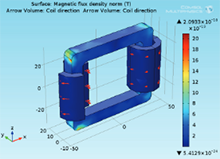
The conductivity of seawater directly correlates with the concentration of dissolved salts. This model demonstrates a new approach to the methodology of inductive conductivity measurement of seawater and other liquids. COMSOL Multiphysics® was used to build a parametrically swept model ... Per saperne di più
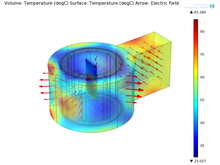
We will present the issues of a microreactor setup designed for microwave organic synthesis and demonstrate how COMSOL Multiphysics® is used to understand the mechanism of microwave heating and improve the microreactor design. The RF Module was used for the electromagnetics and solid ... Per saperne di più
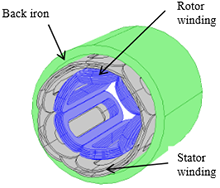
High temperature superconductors (HTS) such as YBCO coated conductors show great promise for future applications where high magnetic fields are needed. The superconducting state only exists under a critical surface defined in the (J,T,B) space. Quench is the process by which a current ... Per saperne di più
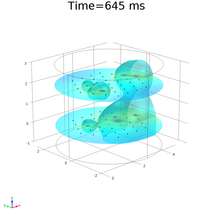
This paper utilizes the COMSOL Multiphysics® general form PDE interface and MATLAB® to model stochastic calcium waves in a sarcomere (basic unit of a heart cell). The model we present here shows the evolution of waves generated from calcium being released stochastically from sites ... Per saperne di più
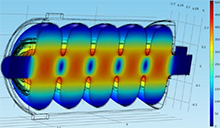
Project X is a proposed proton accelerator complex at Fermilab. The CW LINAC is based on five types of resonators operating at three frequencies: half-wave, spoke, and elliptical. The low beam current for the CW operation of Project X requires cavities to operate at a high loaded Q and, ... Per saperne di più
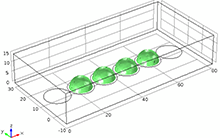
We describe simulations performed in COMSOL Multiphysics® of the precipitation of helium (He) on solid-state interfaces. The non-uniform precipitation of He at certain interfaces is a result of a heterogeneous energy distribution in the interface plane: He wets high interface energy ( ... Per saperne di più
Normal conducting cavities are typically used in the front end of proton accelerators to get the beam accelerated to velocities approximately a few tenths of the speed of light, where superconducting cavities can then be used to accelerate the beam to the speed of light. The warm part of ... Per saperne di più