
Scopri come la simulazione multifisica viene utilizzata per ricerca e sviluppo
La modellazione e simulazione multifisica favorisce l’innovazione in numerosi settori industriali e nel mondo accademico, come dimostrano le molteplici applicazioni illustrate negli articoli tecnici e nei poster presentati ogni anno da ingegneri, ricercatori e scienziati alla COMSOL Conference.
Lasciati ispirare dai recenti contributi raccolti qui sotto oppure, per trovare una presentazione specifica o filtrare i risultati per area di applicazione, anno o sede della conferenza, utilizza lo strumento di Ricerca Rapida.
Visualizza gli articoli presentati alla COMSOL Conference 2025
COMSOL Multiphysics® is used to simulate thermal flow experiments at out University for Applied Physics. Students have to measure thermal flow problems and verify the measurements with detailed simulations. The desired accuracy is 5% or less. The presentation will cover 3 laboratory ... Per saperne di più
Greenhouse gases trap heat and make the planet warmer. The main greenhouse gases emitted by human activities are: Carbon dioxide (CO2). The use of fossil fuel is the primary source of CO2 [1, 2]. Accordingly, there is a need for an efficient and novel separation processes for removal of ... Per saperne di più
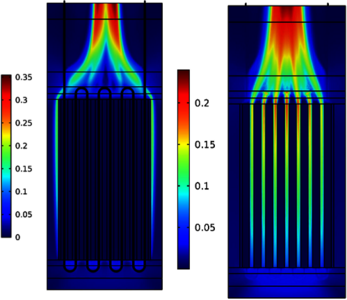
We present a numerical investigation on a metal foam radiator in natural convection. Metal foams are innovative lightweight materials with unique heat dissipation properties. COMSOL Multiphysics® has been used to reproduce experimental data and generate an optimized geometry to maximize ... Per saperne di più
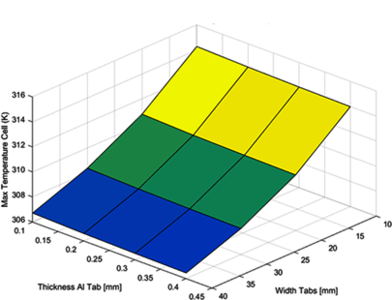
OXIS Energy Ltd is a pioneer in the research and development of Lithium Sulfur batteries. Scaling up from R&D level coin cells to pouch cells for automotive use, engineering design and thermal management start to become critical. In this study, heat flow at various levels of the cell ... Per saperne di più

A promising method for low cost production of efficient silicon thin film solar cells is the electron beam physical vapor deposition (EB-PVD) of high purity amorphous silicon (a-Si) layers with high deposition rates up to 300 nm/s [1] followed by crystallization. This study focuses on EB ... Per saperne di più
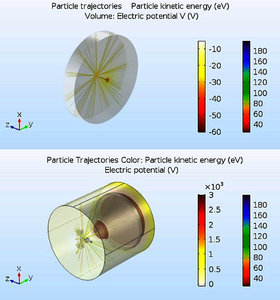
The recently developed technique Scanning Tunneling Microscopy in the Field Emission regime (STM FE) is based on the Russell Young's topografiner technology. The set-up is a no contacting device consisting of a sharp tip approached vertically to a conducting surface at variable distances ... Per saperne di più
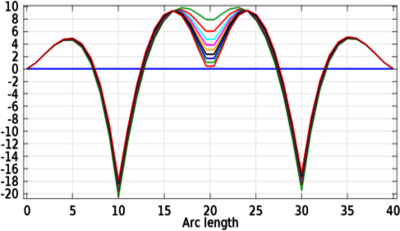
The Geoenvironmental Engineering Group of the University of Castilla-La Mancha is developing a computational tool, M4B, for describing the influence of environmental loads on the deformation behavior of soils and its interaction with building foundations. This tool comprises a set of ... Per saperne di più

We have developed a small environmental chamber to expose a sample to adjustable climate conditions. This climate chamber will be used as sample environment for small-angle neutron scattering (SANS) experiments. SANS is a favorable measuring method, to explore structural changes on the ... Per saperne di più
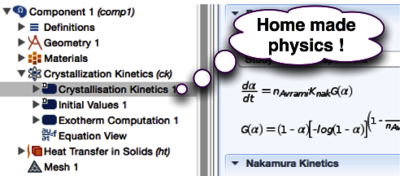
Crystallization phenomena are of first interest in several industrial applications (polymer forming processes, metallurgy, phase change flow, energy storage...). A classical way to model the crystallization evolution is using the Nakamura kinetics law. In this paper, a novel physics ... Per saperne di più

High power CO2 lasers have been the workhorses for sheet metal cutting, welding and many more applications in materials processing during the past decades. Even though a significant replacement by fiber coupled lasers takes place, there are still many applications that benefit from the ... Per saperne di più


