Scopri come la simulazione multifisica viene utilizzata in tutto il mondo per ricerca e sviluppo
La modellazione e simulazione multifisica favorisce l’innovazione in numerosi settori industriali e nel mondo accademico, come dimostrano le molteplici applicazioni illustrate negli articoli tecnici e nei poster presentati ogni anno da ingegneri, ricercatori e scienziati alla COMSOL Conference.
Lasciati ispirare dai recenti contributi raccolti qui sotto oppure, per trovare una presentazione specifica o filtrare i risultati per area di applicazione, anno o sede della conferenza, utilizza lo strumento di Ricerca Rapida.
Visualizza gli articoli presentati alla COMSOL Conference 2026
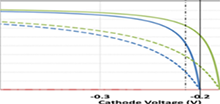
Most conventional wastewater treatment processes are quite energy-intensive. Global wastewater production is increasing due to growth in population, industrialization, and urbanization, creating an urgent need for energy-efficient wastewater treatment technologies. Moreover, waste ... Per saperne di più
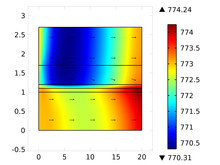
This paper presents a 2D model of an intermediate temperature ammonia-fed SOFC (400 – 700 °C) based on the Temkin-Pyzhev model of ammonia decomposition. Phenomenological equations are implemented in COMSOL Multiphysics®. The Dusty Gas Model is used to model species transport in porous ... Per saperne di più

This project modeled an industrial chromium plating process for automotive components. The process was modeled via the COMSOL Multiphysics® Electrodeposition Module. The simulation examined the effect of solution conductivity, electrode spacing, and anode height utilizing a factorial ... Per saperne di più
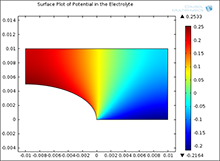
Galvanic corrosion is encountered in marine applications because one often has dissimilar metal joints and seawater acts as an electrolyte. One metal acts predominantly as anode and undergoes material dissolution while the other acts predominantly as cathode and is the site where a ... Per saperne di più

A characteristic feature of nanochannels is that surface properties (e.g., electrical charge) play a more significant role in the transport of fluid and electrolyte. Two oppositely directed flows (electroosmotic flow and pressure-driven flow) determine the flow profile at the nanopore ... Per saperne di più

The reciprocating paddle cell is a known practical method for depositing alloy films on wafer substrates. Recently, the mass transfer boundary layer within an industrial wafer plating cell was studied based on the measurement of limiting current. It was indicated that a shear-plate fluid ... Per saperne di più
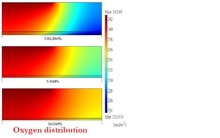
Proton exchange membrane fuel cells (PEMFCs) were investigated using COMSOL Multiphysics with the AC/DC Module and Chemical Engineering Module. Simulation may be used to increase the performance while decreasing the cost of the catalyst later (CL). Experimental validation of single and ... Per saperne di più
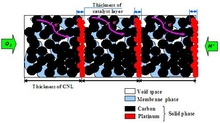
We present a novel multi-layered electrode fabrication technique for polymer electrolyte membrane fuel cells (PEMFCs). This method consists of alternate layers of Pt deposition (0.05 mg/cm²) by sputtering on the painted multi-walled carbon-Nafion layer (CNL) with larger concentration of ... Per saperne di più