
Thermal Response of OTEC Cold-Water Pipes: A COMSOL Multiphysics Study
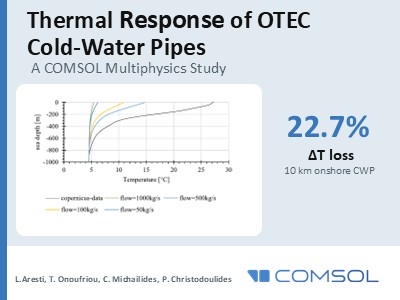
Ocean Thermal Energy Conversion (OTEC) systems exploit the temperature difference between warm surface seawater and cold deep seawater to produce electricity or useful by-products. Because OTEC cycles operate with relatively small temperature differences, even minor heat gains in the cold-water pipe (CWP) can significantly affect the effective temperature difference available at the condenser and, consequently, the system efficiency. In many OTEC performance studies, the cold seawater temperature at the pipe intake is assumed to be equal to the condenser inlet temperature, neglecting heat transfer along the CWP. This assumption can lead to optimistic performance estimates, particularly for onshore systems requiring long intake pipes. This work investigates the effect of CWP heat losses on the performance assessment of OTEC systems using COMSOL Multiphysics v6.3. A transient numerical model was developed to simulate the convective and conductive heat transfer between the cold seawater flowing inside the pipe and the surrounding marine environment. The model was implemented using the Heat Transfer in Pipes interface with a simplified 1D pipe approach, which enables efficient simulation of long pipes while avoiding the high computational cost associated with full-scale 2D or 3D modelling. The governing heat transfer formulation accounts for internal convection, pipe-wall conduction, external seawater temperature variation with depth, and friction-related effects. Seawater properties were treated as temperature- and pressure-dependent, with density estimated using the TEOS-10 formulation and introduced into the model through interpolation functions. A parametric analysis was performed for different CWP lengths, diameters, mass flowrates, pipe materials, and system configurations. The studied pipe lengths represent both offshore floating systems with shorter vertical CWPs and onshore systems requiring longer pipes to reach suitable deep-sea temperatures. HDPE and FRP pipe materials were considered, and the thermal results were combined with hydraulic head-loss calculations to estimate the required pumping power. The results show that CWP heat gains can substantially reduce the effective temperature difference available to the OTEC cycle. For a 10 km CWP, the condenser inlet temperature reached approximately 8.7 °C despite an initial deep seawater temperature of 4.5 °C, reducing the available temperature difference by about 22.7%. The CWP length was found to be a dominant parameter, while pipe diameter had a relatively limited effect on the outlet temperature. Offshore configurations with shorter CWPs reduced the temperature difference losses by up to 86% compared with long onshore configurations. Pumping power increased strongly with CWP length and mass flowrate, highlighting the need for integrated thermal and hydraulic design. The study demonstrates that site-specific CWP heat transfer modelling is essential for realistic OTEC performance assessment. COMSOL Multiphysics provides an efficient platform for evaluating these coupled thermal and hydraulic effects and supporting the design of more reliable and viable OTEC systems.
Download
- 17881_final_poster.pdf - 0.78MB


