
La Galleria delle Applicazioni raccoglie un'ampia varietà di tutorial e di app dimostrative realizzati con COMSOL Multiphysics in diversi ambiti applicativi, inclusi quelli elettrico, meccanico, fluidico e chimico. E' possibile scaricare i file dei modelli e delle app demo pronti all'uso e le istruzioni step-by-step per costruirli, e utilizzarli come punto di partenza per le proprie simulazioni.
Lo strumento di Ricerca Rapida permette di trovare i modelli che si riferiscono alla propria area di interesse.
Si noti che molti degli esempi qui presentati sono accessibili anche tramite le Librerie delle Applicazioni incorporate nel software COMSOL Multiphysics® e disponibili dal menu File.
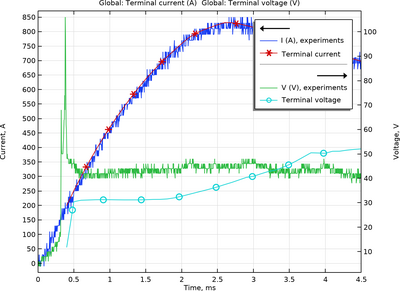
This model presents a 2D simulation of transient arc discharge movement along guided copper rails. While accurately modeling transient arcs typically requires a 3D simulation, the 2D approach offers greater efficiency and remains valuable for initial investigations and demonstration ... Per saperne di più
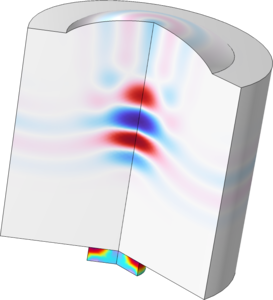
Piezoelectric devices are widely used as sources to generate sound waves or receivers to detect acoustic signals. In applications such as ultrasound imaging and nondestructive testing, the same transducer can be used as a transmitter to send a source signal and receiver to detect ... Per saperne di più
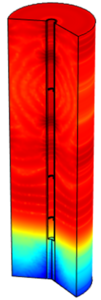
This model demonstrates how to simulate a piezoelectric transducer as both a sound transmitter and a receiver in a well logging setup. Other applications of this setup are, for example, in the field of nondestructive testing. A transmitting transducer is connected to an electrical ... Per saperne di più
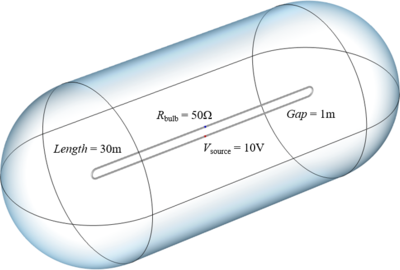
This model is used to demonstrate the solution to a classic brainteaser in electromagnetics. A long loop of wire is connected to a source and a receiver, which are placed 1 meter apart. The objective of the model is to compute how long it takes for the receiver to sense when the source ... Per saperne di più
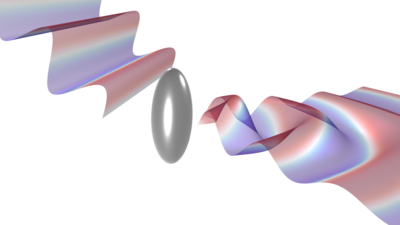
Electromagnetic scattering simulation for an object with continuous rotational symmetry can be performed in 2D axisymmetry instead of 3D to drastically reduce computational time and resources. This model shows how to simulate arbitrary plane wave incidence in 2D axisymmetric models by ... Per saperne di più
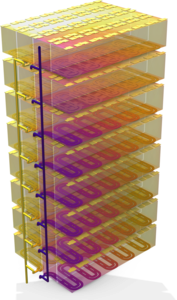
High-power battery energy storage systems (BESS) are often equipped with liquid-cooling systems to remove the heat generated by the batteries during operation. This tutorial demonstrates how to define and solve a high-fidelity model of a liquid-cooled BESS pack which consists of 8 ... Per saperne di più
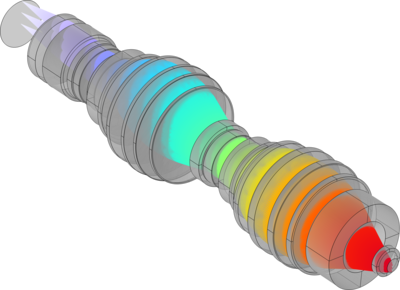
Microlithography lenses are used to project the image of an integrated circuit onto a silicon substrate. This tutorial demonstrates how to create a 21-element fused silica lens which has a NA of 0.56 which is designed to be used at a wavelength of 248nm. The lens, which has a total ... Per saperne di più

A spherical water-rich load (potato) is placed on the rotating glass tray of a microwave oven some distance from the center of rotation. 1 kW of 2.45 GHz microwave power is applied via a waveguide feed. The plate rotates at 9 degrees per second. The heat transfer model involves the ... Per saperne di più
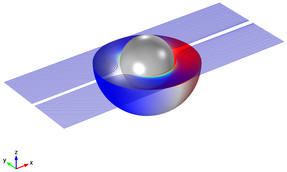
This model demonstrates the use of optical tracing for studying optically large gradient-index structures with anisotropic optical properties. Additionally, the model introduces a smoothing technique for handling discontinuities of refractive index on curved surfaces, which are typical ... Per saperne di più

Differential inductance is relevant when a low-frequency electromagnetic system includes magnets, nonlinear magnetic materials, and moving parts. These models present examples of computing the differential inductance and using these within simplified lumped models. To learn more about ... Per saperne di più


