
La Galleria delle Applicazioni raccoglie un'ampia varietà di tutorial e di app dimostrative realizzati con COMSOL Multiphysics in diversi ambiti applicativi, inclusi quelli elettrico, meccanico, fluidico e chimico. E' possibile scaricare i file dei modelli e delle app demo pronti all'uso e le istruzioni step-by-step per costruirli, e utilizzarli come punto di partenza per le proprie simulazioni.
Lo strumento di Ricerca Rapida permette di trovare i modelli che si riferiscono alla propria area di interesse.
Si noti che molti degli esempi qui presentati sono accessibili anche tramite le Librerie delle Applicazioni incorporate nel software COMSOL Multiphysics® e disponibili dal menu File.
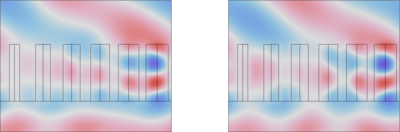
This model is based on the Metasurface Beam Deflector model. The performance is improved using shape optimization by allowing both the radii and the position of the individual pillars to change. Per saperne di più
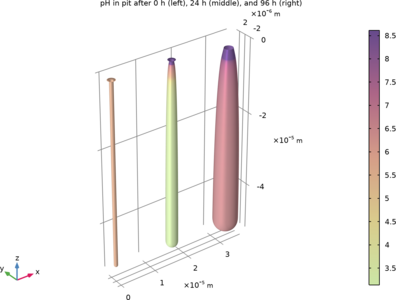
Pitting corrosion is localized corrosion by which local cavities, pits, are formed on a seemingly initially smooth metal surface. A pit may be initiated due to small surface defects, such as inhomogeneities in composition or shape, or from mechanical abuse. How and if the pit grows ... Per saperne di più
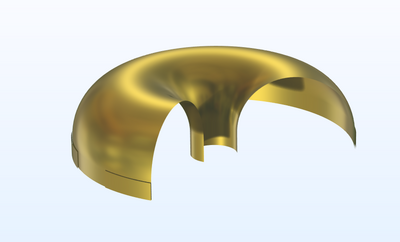
This tutorial demonstrates how to model a gyroscope based on the birdbath resonator gyroscope (BRG) design. The BRG is a type of Coriolis vibratory gyroscope (CVG) invented at the University of Michigan as a navigation-grade gyroscope in the mm-scale. This tutorial shows how the ... Per saperne di più
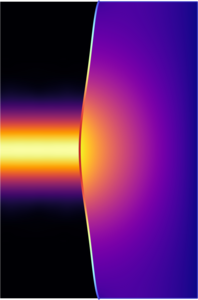
The thermal effects of a laser beam incident on a Semiconductor Saturable Absorber Mirror (SESAM) are simulated under a range of incident beam powers. This is done in two steps. The first study simulates the multiphysics combination of the saturated absorption of the beam on a SESAM, ... Per saperne di più
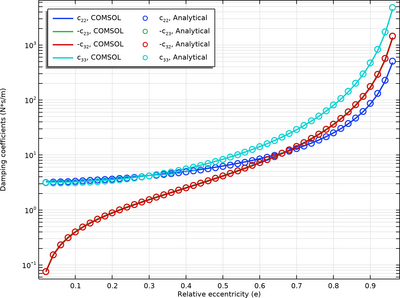
Squeeze film dampers are components that provide additional damping to rotating machines. To simplify the modeling of a rotor assembly, squeeze film dampers are modeled in terms of their damping coefficients which are a functions of the journal location in the damper. This model computes ... Per saperne di più
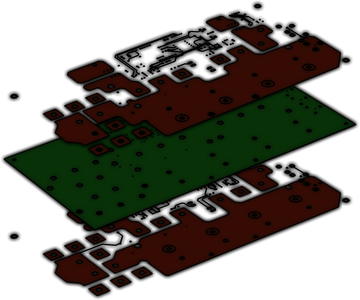
This tutorial model shows how to import data from an ODB++® archive to generate a geometry of a printed circuit board (PCB). Follow the instructions to learn how to remove small details from the geometry, create a mesh, and use automatically generated selections to define physics and ... Per saperne di più

This tutorial demonstrates the operation of a gyroscope based on design provided by Dr. James Ransley at Veryst Engineering, LLC. The model uses the Electromechanics coupling with the mixed finite element formulation in the Electrostatics interface. Per saperne di più
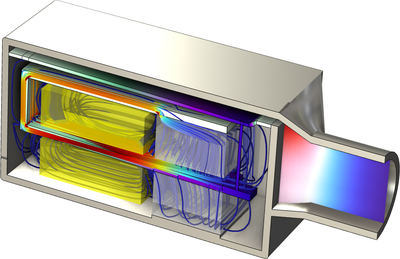
This is a full vibro-electroacoustic simulation of a balanced armature transducer (BAT also known as a receiver in some industries) which is a high performance miniature loudspeaker often used in hearing aids and other in-ear audio products. The model is set up using a linear frequency ... Per saperne di più
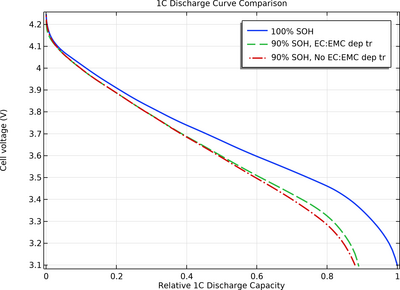
The liquid electrolyte in lithium-ion batteries (LIBs) typically consists of a lithium salt, such as LiPF6, dissolved in one or several solvents. Commercial LIBs commonly employ a mix of multiple hydrocarbon-based solvents along with additional additives. In an electrolyte consisting of ... Per saperne di più
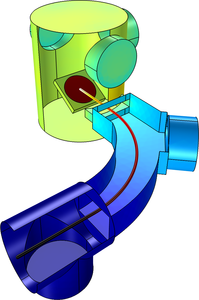
Ion implantation is used extensively in the semiconductor industry to implant dopants into wafers. Within an ion implanter, ions generated within an ion source are accelerated by an electric field to achieve the desired implant energy. Ions of the correct charge state are selected by ... Per saperne di più


