
La Galleria delle Applicazioni raccoglie un'ampia varietà di tutorial e di app dimostrative realizzati con COMSOL Multiphysics in diversi ambiti applicativi, inclusi quelli elettrico, meccanico, fluidico e chimico. E' possibile scaricare i file dei modelli e delle app demo pronti all'uso e le istruzioni step-by-step per costruirli, e utilizzarli come punto di partenza per le proprie simulazioni.
Lo strumento di Ricerca Rapida permette di trovare i modelli che si riferiscono alla propria area di interesse.
Si noti che molti degli esempi qui presentati sono accessibili anche tramite le Librerie delle Applicazioni incorporate nel software COMSOL Multiphysics® e disponibili dal menu File.

A spherical water-rich load (potato) is placed on the rotating glass tray of a microwave oven some distance from the center of rotation. 1 kW of 2.45 GHz microwave power is applied via a waveguide feed. The plate rotates at 9 degrees per second. The heat transfer model involves the ... Per saperne di più
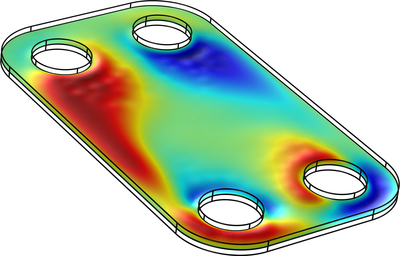
This model demonstrates how to use the built-in shape optimization functionality to improve the performance of a plate heat exchanger. The optimization reduces the path immediately in front of the inlets and outlets to increase the length of typical streamlines. This leads to a improved ... Per saperne di più

This example is a benchmark problem for simulating phase change in porous media. It studies the melting process of an ice inclusion within porous media and therefore demonstrates how to couple Darcy's Law with the Heat Transfer in Porous Media interface including phase change. Per saperne di più
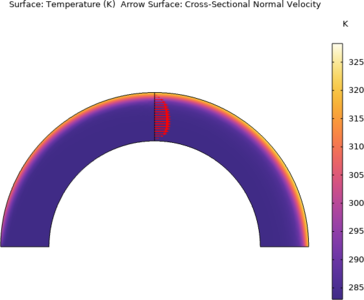
This tutorial illustrates how to use built-in variables and operators, for the evaluation of the bulk temperature along a geometry like a channel, a pipe or a chimney, in a nonisothermal flow in 2D and 3D. The bulk temperature may be needed to compute the heat transfer coefficient for an ... Per saperne di più
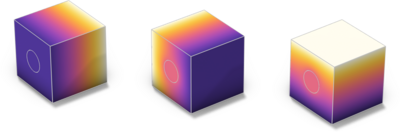
In this example, a heat transfer model of a fiber composite's unit cell is analyzed with the Cell Periodicity feature. The homogenized thermal conductivity, density and heat capacity of a composite material are computed based on the individual properties of fiber and matrix. A comparison ... Per saperne di più
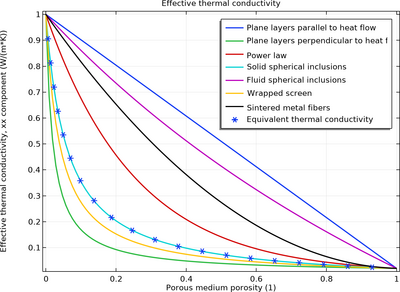
This tutorial presents the averaging models available within the Heat Transfer in Porous Media interface, used to compute the effective thermal conductivity, when the local thermal equilibrium assumption is made. The models are compared for porosities ranging from 0 to 1, and for a ... Per saperne di più
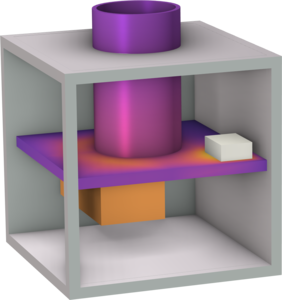
This model demonstrates how to compute satellite temperature over multiple orbit periods by coupling Orbital Thermal Loads to Heat Transfer in Solids. The direct solar, albedo, and Earth infrared thermal loads are computed over a single orbit, and are periodically repeated over multiple ... Per saperne di più

Composite materials are often used in structural applications, where the ability to tailor properties such as stiffness and strength make them attractive compared to traditional engineering materials. In addition to structural applications, composites are also used in applications where ... Per saperne di più
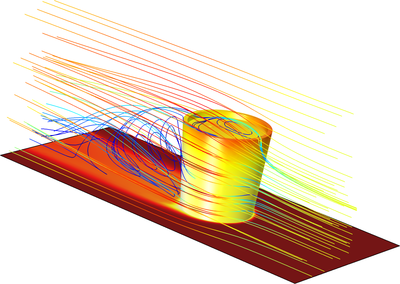
This tutorial shows how to couple three physics interfaces to model evaporative cooling. The effects that need to be taken into account are heat transfer, transport of water vapor, and fluid flow. The Wet Surface feature is used to implement the source term for the water vapor and to ... Per saperne di più

This example shows how to set up multiple sandwiched thin layers with different thermal conductivities in two different ways. First, the composite is modeled as a 3D object. In the second approach, the thin domains are modeled with thermal resistors in the Lumped Thermal System ... Per saperne di più