
La Galleria delle Applicazioni raccoglie un'ampia varietà di tutorial e di app dimostrative realizzati con COMSOL Multiphysics in diversi ambiti applicativi, inclusi quelli elettrico, meccanico, fluidico e chimico. E' possibile scaricare i file dei modelli e delle app demo pronti all'uso e le istruzioni step-by-step per costruirli, e utilizzarli come punto di partenza per le proprie simulazioni.
Lo strumento di Ricerca Rapida permette di trovare i modelli che si riferiscono alla propria area di interesse.
Si noti che molti degli esempi qui presentati sono accessibili anche tramite le Librerie delle Applicazioni incorporate nel software COMSOL Multiphysics® e disponibili dal menu File.
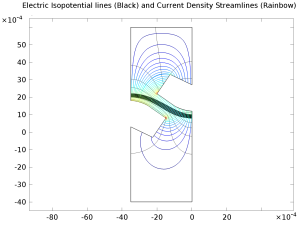
The chlor-alkali membrane process is one of the largest in industrial electrolysis with the production of roughly 40 million metric tons of both chlorine and caustic soda per year. Chlorine is used predominantly for the production of vinyl chloride monomer, which in turn is used for the ... Per saperne di più
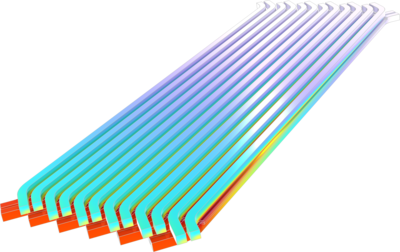
In a polymer electrolyte membrane fuel cell (PEMFC), water is produced at the cathode. The cell is also fed with water vapor via the inlet gas streams, in order to keep the polymer electrolyte membrane humidified. If the water partial pressure in the gas phase exceeds the vapor ... Per saperne di più
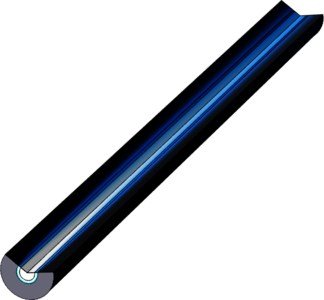
Dialysis is a widely used chemical species separation method. One such example is hemodialysis, which acts as artificial kidneys for people with renal failure. In dialysis, only specific components are allowed to diffuse through the membrane, based on differences in molecular size and ... Per saperne di più
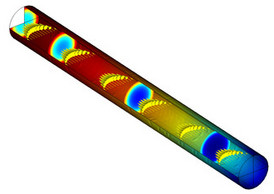
Tubular reactors are often used in continuous large-scale production, for example in the petroleum industry. One key design parameter is the conversion, or the amount of reactant that reacts to form the desired product. In order to achieve high conversion, process engineers optimize the ... Per saperne di più
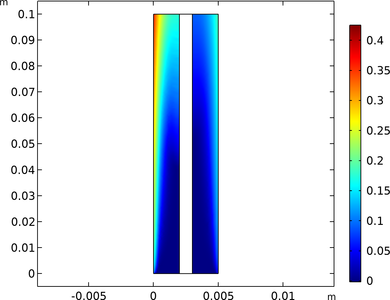
Alkaline water electrolysis is a well-established industrial process for producing hydrogen gas. In the cell, hydrogen gas is formed at the cathode whereas oxygen gas is formed at the anode. The electrolyte is an aqueous liquid, and when the evolved gases form bubbles, the effective ... Per saperne di più
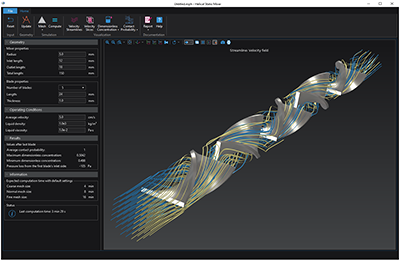
This app demonstrates the following: Geometry parts and parametric geometries Dark theme Use of subwindows Material appearance visualization with environment reflections Report generation for both Microsoft® Word and Microsoft® PowerPoint Options for setting different mesh sizes ... Per saperne di più
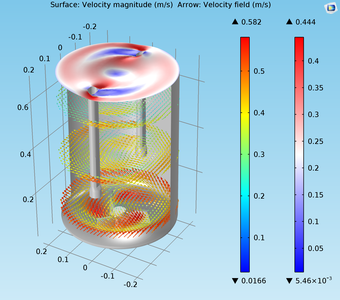
This example of turbulent flow in a partially baffled turbulent mixer shows how to set up The Rotating Machinery, Turbulent Flow interfaces from the Mixer Module with free surface and stationary free surface features. Both frozen rotor and time-dependent simulations are performed and ... Per saperne di più
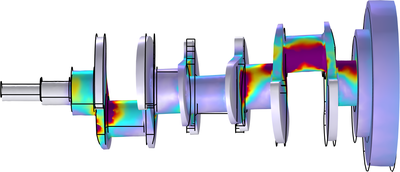
See how to perform a vibration analysis of the crankshaft of a 3-cylinder reciprocating engine in this tutorial model. Due to the eccentricity of the crank-pin and balance masses on the crankshaft, it undergoes self-excited vibration under rotation. The crankshaft is modeled using solid ... Per saperne di più
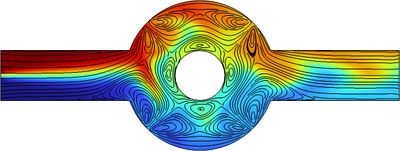
Microlaboratories for biochemical applications often require rapid mixing of different fluid streams. At the microscale, flow is usually highly ordered laminar flow, and the lack of turbulence makes diffusion the primary mechanism for mixing. While diffusional mixing of small ... Per saperne di più
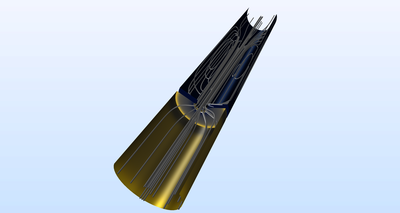
This example considers the turbulent flow of an oil-water suspension through an orifice. The oil droplets are broken up into smaller droplets by the turbulent stresses as the suspension passes through the orifice. The aim of this model is to track the distribution of droplet sizes. The ... Per saperne di più


