
La Galleria delle Applicazioni raccoglie un'ampia varietà di tutorial e di app dimostrative realizzati con COMSOL Multiphysics in diversi ambiti applicativi, inclusi quelli elettrico, meccanico, fluidico e chimico. E' possibile scaricare i file dei modelli e delle app demo pronti all'uso e le istruzioni step-by-step per costruirli, e utilizzarli come punto di partenza per le proprie simulazioni.
Lo strumento di Ricerca Rapida permette di trovare i modelli che si riferiscono alla propria area di interesse.
Si noti che molti degli esempi qui presentati sono accessibili anche tramite le Librerie delle Applicazioni incorporate nel software COMSOL Multiphysics® e disponibili dal menu File.
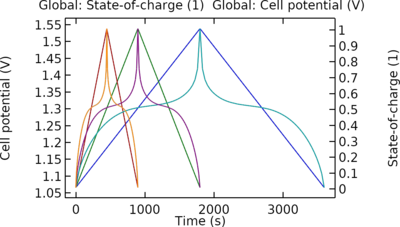
A simple equivalent circuit model approach is presented for Nickel metal hydride batteries. The 0D model consists of resistor, capacitor, current source and state-of-charge based voltage source (SOC). An Arrhenius type dependence is used to account for self-discharge. All model ... Per saperne di più
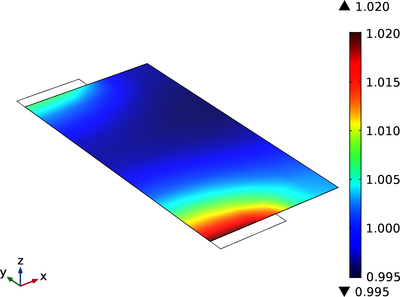
Large lithium-ion batteries are widely deployed in electric vehicles and for stationary energy storage applications. In the (stacked) pouch battery cell design, all current exits the cell on the cell "tabs", and as the cell size and power increase, the voltage gradients in the highly ... Per saperne di più
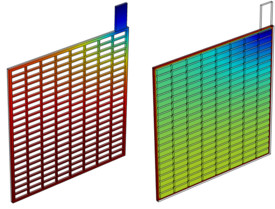
This 3D model example demonstrates the use of the Primary Current Distribution interface for modeling current distributions in electrochemical cells. In primary current distribution, the potential losses due to electrode kinetics and mass transport are assumed to be negligible, and ... Per saperne di più

This tutorial digs deeper into the investigation of rate capability in a battery and shows how the Lithium-Ion Battery interface is an excellent modeling tool for doing this. The rate capability is studied in terms of polarization (voltage loss) or the internal resistance causing this ... Per saperne di più
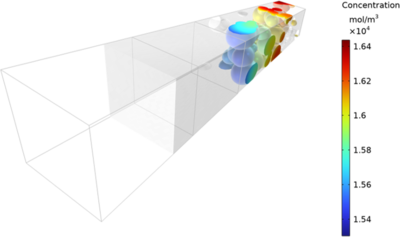
Solid-state batteries (SSB) are a promising technology that could suffer from internal mechanical stresses due to the growth and shrinkage of the electrodes within all-solid components. With this model, the charge-discharge cycling of an SSB is simulated with a focus on the interaction ... Per saperne di più
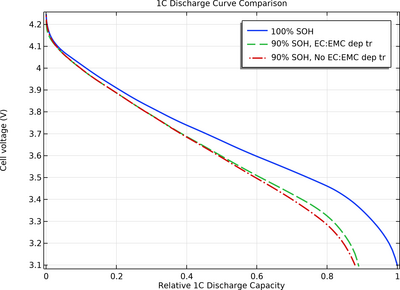
The liquid electrolyte in lithium-ion batteries (LIBs) typically consists of a lithium salt, such as LiPF6, dissolved in one or several solvents. Commercial LIBs commonly employ a mix of multiple hydrocarbon-based solvents along with additional additives. In an electrolyte consisting of ... Per saperne di più
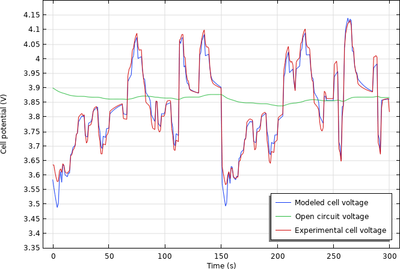
This tutorial uses an equivalent circuit approach for modeling the performance of a lithium-ion battery, requiring no knowledge about the internal chemistry or structure of the battery. A 0D equivalent circuit battery model is defined based on a resistor connected in series with a ... Per saperne di più
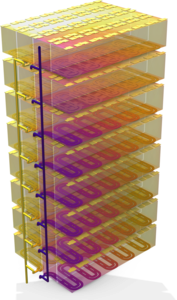
High-power battery energy storage systems (BESS) are often equipped with liquid-cooling systems to remove the heat generated by the batteries during operation. This tutorial demonstrates how to define and solve a high-fidelity model of a liquid-cooled BESS pack which consists of 8 ... Per saperne di più

Electrode balancing is an important factor in the design of lithium-ion batteries. In this model, use the experimental open-circuit voltage of a cell and some basic assumptions, followed by an optimization solver, to find a proper electrode balancing. Get more details in this ... Per saperne di più

Prismatic lithium cells are widely used in electric vehicles and battery energy storage systems. This example demonstrates the use of the Lithium-Ion Battery interface for a full 3D prismatic battery equipped with two jelly rolls. The model defines a full so-called Newman model but ... Per saperne di più