
La Galleria delle Applicazioni raccoglie un'ampia varietà di tutorial e di app dimostrative realizzati con COMSOL Multiphysics in diversi ambiti applicativi, inclusi quelli elettrico, meccanico, fluidico e chimico. E' possibile scaricare i file dei modelli e delle app demo pronti all'uso e le istruzioni step-by-step per costruirli, e utilizzarli come punto di partenza per le proprie simulazioni.
Lo strumento di Ricerca Rapida permette di trovare i modelli che si riferiscono alla propria area di interesse.
Si noti che molti degli esempi qui presentati sono accessibili anche tramite le Librerie delle Applicazioni incorporate nel software COMSOL Multiphysics® e disponibili dal menu File.
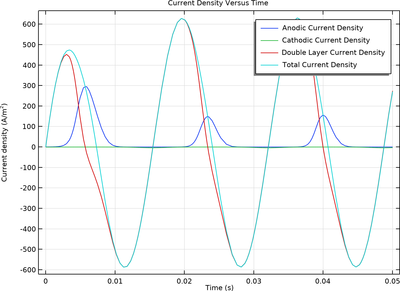
Corrosion induced due to alternating current (AC) is evident in the oil and gas industry, particularly when a pipeline is in close proximity to the high power transmission lines. A numerical model presented here first evaluates the effect of direct current (DC) applied potential on ... Per saperne di più

The mutual inductance between a primary and secondary single turn coil in a concentric coplanar arrangement is computed using a DC, steady-state, model and compared against the analytic solution. The induced currents in the secondary coil are computed using an AC, frequency-domain, ... Per saperne di più

This model illustrates the use of COMSOL Multiphysics for modeling of ionic current distribution problems in electrolytes, in this case in human tissue. The problem is exemplified on a pacemaker electrode, but it can be applied in electrochemical cells like fuel cells, batteries, ... Per saperne di più
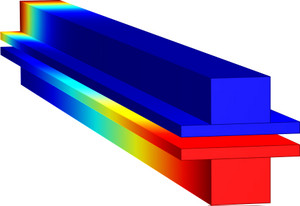
This model presents a study of the current density distribution in a solid oxide fuel cell (SOFC). The model includes the full coupling between the mass balances at the anode and cathode, the momentum balances in the gas channels, the gas flow in the porous electrodes, the balance of ... Per saperne di più
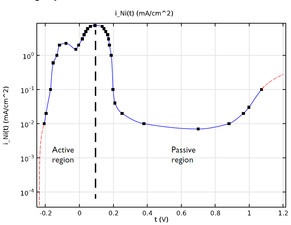
This model exemplifies the basic principles of crevice corrosion and how a time-dependent study can be used to simulate the electrode deformation. The model is in 2D and the polarization data for the corrosion reaction is taken from a paper by Absulsalam and others. The model and the ... Per saperne di più
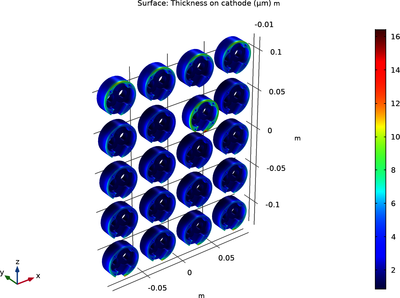
When several components are to be electroplated they are typically mounted on a rack in the electroplating bath. An important aspect is then achieving a uniform thickness of the plated layer for all components mounted on the rack. This example model allows for investigating the effect ... Per saperne di più
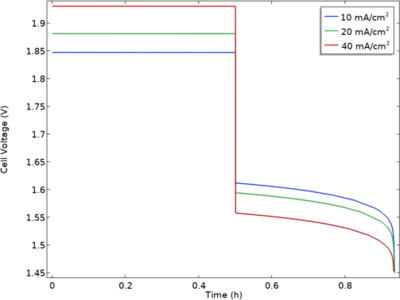
The zinc bromine redox flow battery is an electrochemical energy storage technology suitable for stationary applications. Compared to other flow battery chemistries, the Zn-Br cell potentially features lower cost, higher energy densities and better energy efficiencies. In the cell ... Per saperne di più
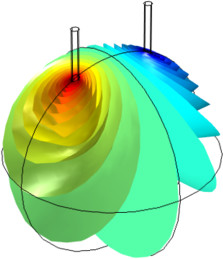
This tutorial example models the currents and the concentration of dissolved metal ions in a battery (corrosion cell) made from an orange and two metal nails. This type of battery is commonly used in chemistry lessons. Instead of an orange, lemons or potatoes can also be used. Per saperne di più
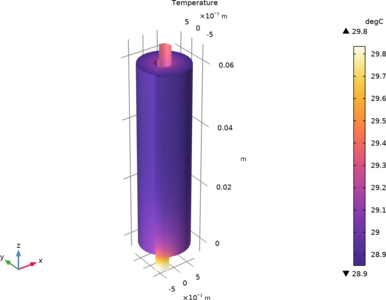
In a cylindrical or prismatic battery cell, the active layers, current collector metal foils and separators are wound into a “jelly roll”. Additional tabs (metal strips) are welded to the current collector foils in order to conduct the current to the exterior of the cell can. The ... Per saperne di più
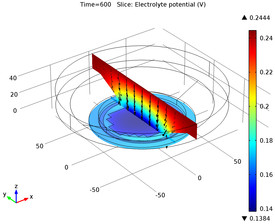
This example models time-dependent copper deposition on a resistive wafer in a cupplater reactor. As the deposited layer builds up, the resistive losses of the deposited layer decreases. The benefit of using a current thief for a more uniform deposit is demonstrated. Per saperne di più