
La Galleria delle Applicazioni raccoglie un'ampia varietà di tutorial e di app dimostrative realizzati con COMSOL Multiphysics in diversi ambiti applicativi, inclusi quelli elettrico, meccanico, fluidico e chimico. E' possibile scaricare i file dei modelli e delle app demo pronti all'uso e le istruzioni step-by-step per costruirli, e utilizzarli come punto di partenza per le proprie simulazioni.
Lo strumento di Ricerca Rapida permette di trovare i modelli che si riferiscono alla propria area di interesse.
Si noti che molti degli esempi qui presentati sono accessibili anche tramite le Librerie delle Applicazioni incorporate nel software COMSOL Multiphysics® e disponibili dal menu File.

Fluence rate is a key parameter for ultraviolet (UV) water purifier. It describes the amount of radiation that pathogens absorb and is then directly related to the disinfection level of the purifier. The aim of this example is to demonstrate the fluence rate calculation with the ... Per saperne di più

This app demonstrates the following: Parameterized geometries Visualizing material appearance, color, and texture Multiple plots in the same window to visualize the results Options to visualize the results with different views using check boxes Microstrip patch antenna arrays are ... Per saperne di più
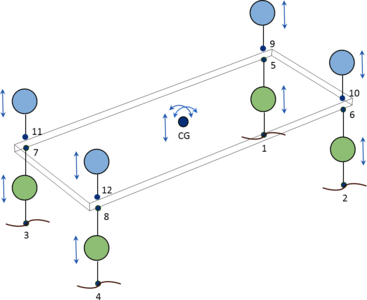
In this example, a lumped model of a vehicle suspension system having 11 degrees of freedom is analyzed. The Mass, Spring, and Damper nodes of the Lumped Mechanical System interface are used to model the wheels, including suspension system as well as the seats with a passenger. The ... Per saperne di più
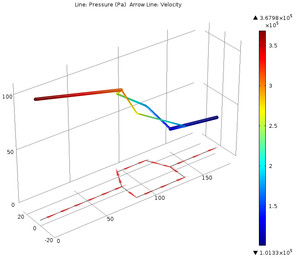
The Pipe Flow interface allows you to simulate non-Newtonian fluids flowing in pipes. This example models a coal slurry being transported in a pipe system where the pipe diameter changes in different sections. The slurry behaves as a non-Newtonian fluid described by the power law model. ... Per saperne di più
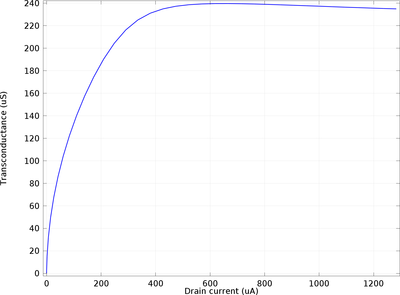
This model shows how to compute the AC characteristics of a MOSFET. Both the output conductance and the transconductance are computed as a function of the drain current. Per saperne di più
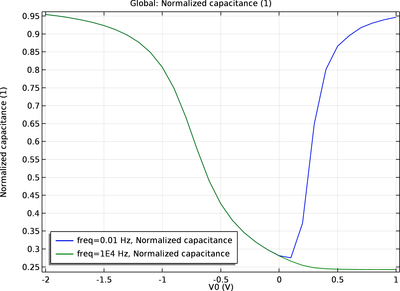
The metal-silicon-oxide (MOS) structure is the fundamental building block for many silicon planar devices. Its capacitance measurements provide a wealth of insight into the working principles of such devices. This tutorial constructs a simple 1D model of a MOS capacitor (MOSCAP). Both ... Per saperne di più
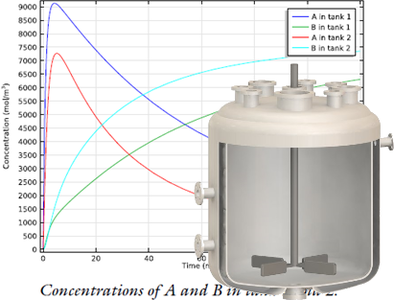
In the chemical and biochemical industries, for instance in fermentation processes, reactors having well-mixed conditions and liquid level control are common. This example shows modeling of a 0D ideal system of tank reactors in series with controlled feed inlet and product outlet ... Per saperne di più

This model demonstrates the caustic effect produced by a cylindrical mirror. It highlights the advantages of the forward ray shooting method when modeling specular reflections from an external radiation source with the Surface-to-Surface Radiation interface. Per saperne di più
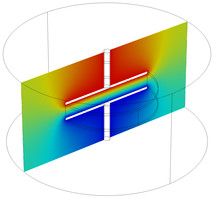
A capacitor with an applied sinusoidally time-varying voltage difference is modeled. A wide frequency range is considered and the impedance of the device is computed. Solver accuracy is addressed. The relationship between the frequency domain impedance and the steady-state capacitance ... Per saperne di più
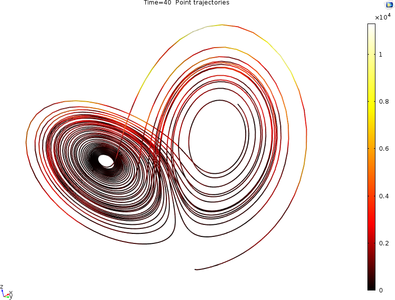
A Lorenz attractor can be described by a system of ordinary differential equations: the Lorenz system. In the early 1960s, Lorenz discovered the chaotic behavior of this system for certain parameter values and initial conditions. The solution, when plotted as a phase space, resembles the ... Per saperne di più


