
La Galleria delle Applicazioni raccoglie un'ampia varietà di tutorial e di app dimostrative realizzati con COMSOL Multiphysics in diversi ambiti applicativi, inclusi quelli elettrico, meccanico, fluidico e chimico. E' possibile scaricare i file dei modelli e delle app demo pronti all'uso e le istruzioni step-by-step per costruirli, e utilizzarli come punto di partenza per le proprie simulazioni.
Lo strumento di Ricerca Rapida permette di trovare i modelli che si riferiscono alla propria area di interesse.
Si noti che molti degli esempi qui presentati sono accessibili anche tramite le Librerie delle Applicazioni incorporate nel software COMSOL Multiphysics® e disponibili dal menu File.
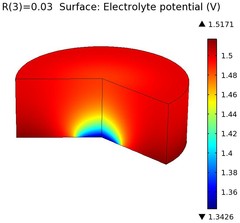
Magnesium alloys are attractive alternatives as lightweight materials in various fields of engineering. Magnesium is however relatively non-noble and may suffer considerable galvanic corrosion when being used in conjunction with other metals, for instance when mounting an Mg alloy ... Per saperne di più

In its simplest form, an optical ring resonator consists of a straight waveguide and a ring waveguide. The waveguides are placed close to each other, making the light affect each between the two structures. If the propagation length around the ring is an integral number of wavelengths, ... Per saperne di più
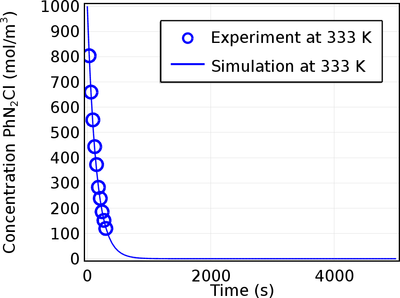
This example shows how to use the Parameter Estimation and Experiment features in the Reaction Engineering interface for optimization with multiple experimental data input files. The application finds the Arrhenius parameters of a first order reaction where Benzene diazonium chloride ... Per saperne di più

This model studies free and forced vibrations of a deep beam. The solution for eigenfrequency, frequency response and transient analysis are computed using a Timoshenko beam and compared with analytical results. Per saperne di più
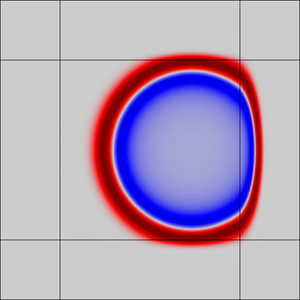
This tutorial simulates a standard test and benchmark model for nonreflecting conditions and sponge layers for linearized Euler-like systems. It involves the propagation of a transient Gaussian pulse in a 2D uniform flow. The Convected Wave Equation, Time Explicit interface solves the ... Per saperne di più
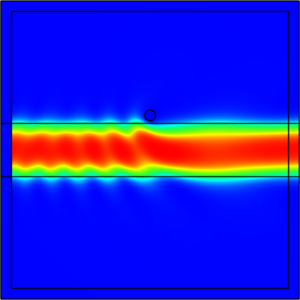
This model includes a dielectric slab waveguide with a small lossy metallic object nearby. The object causes light to be scattered, absorbed, and both reflected and transmitted along the waveguide. Learn more in this accompanying blog post: Modeling a Scatterer Near an Optical Waveguide Per saperne di più
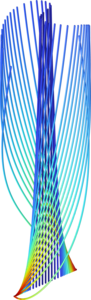
Turbulent flow, SSG-LRR interface is used to analyze fully developed turbulent flow in an axially rotating pipe and in a swirling jet emanating from such a pipe. The resulting flow pattern in the pipe is characterized by slower-than-solid-body rotation. Axial velocity of the swirling jet ... Per saperne di più

In this example, phase transformation data and phase material properties are imported from JMatPro, and used to compute CCT curves. Dilatometry curves (axial thermal strain) are computed across a range of cooling rates. Per saperne di più
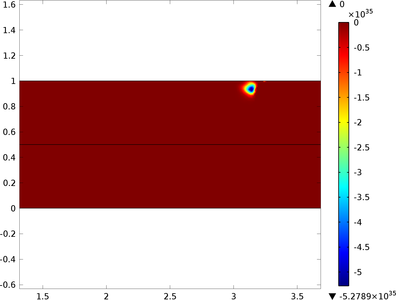
MOSFETs typically operate in three regimes depending on the drain-source voltage for a given gate voltage. Initially the current-voltage relation is linear, this is the Ohmic region. As the drain-source voltage increases the extracted current begins to saturate, this is the saturation ... Per saperne di più

This example resembles the well-known double-slit interference experiment often demonstrated in schools with water waves or sound. The model mimics the plane-wave excitation with two thin waveguides leading to slits in a screen and computes the diffraction pattern on the opposite side of ... Per saperne di più


