
La Galleria delle Applicazioni raccoglie un'ampia varietà di tutorial e di app dimostrative realizzati con COMSOL Multiphysics in diversi ambiti applicativi, inclusi quelli elettrico, meccanico, fluidico e chimico. E' possibile scaricare i file dei modelli e delle app demo pronti all'uso e le istruzioni step-by-step per costruirli, e utilizzarli come punto di partenza per le proprie simulazioni.
Lo strumento di Ricerca Rapida permette di trovare i modelli che si riferiscono alla propria area di interesse.
Si noti che molti degli esempi qui presentati sono accessibili anche tramite le Librerie delle Applicazioni incorporate nel software COMSOL Multiphysics® e disponibili dal menu File.
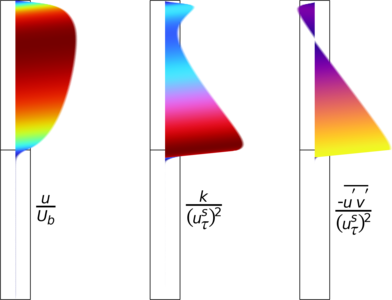
This setup demonstrates how the characteristics of turbulent flow in a channel are modified by the presence of an adjacent porous region. Asymmetric velocity profiles, higher turbulence levels, and higher friction coefficients both at the solid wall and the fluid-porous interface are ... Per saperne di più
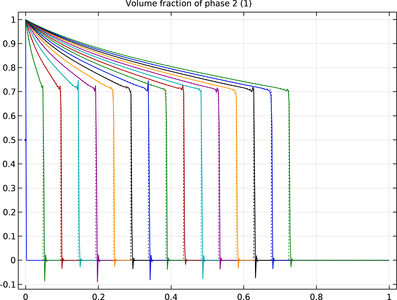
This benchmark models two-phase flow in a porous medium in 1D, where the flow can be analytically described by the Buckley-Leverett equation. Per saperne di più
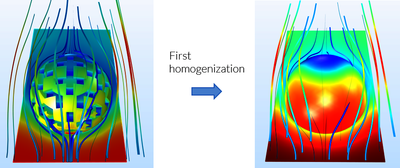
A catalyst particle with a hypothetical microstructure is described in detail. The heterogeneous description is approximated in a second model with a homogeneous particle and the results from the two approaches are compared. See: https://www.comsol.se/blogs/modeling-approaches-in ... Per saperne di più
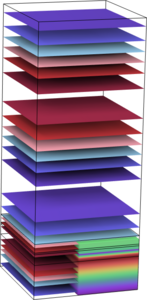
In applications where pressure waves and elastic waves propagate in porous materials filled with air both thermal and viscous losses are important. This is typically the case in insulation materials for room acoustics or lining materials in car cabins. Another example is porous materials ... Per saperne di più

This example is a benchmark problem for simulating phase change in porous media. It studies the melting process of an ice inclusion within porous media and therefore demonstrates how to couple Darcy's Law with the Heat Transfer in Porous Media interface including phase change. Per saperne di più
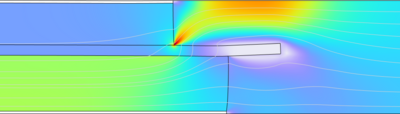
The electrodes of a lithium-ion battery are porous, consisting of an active solid material, a binder, and pores filled with liquid electrolyte. If a force is applied on the porous layers of a battery, this will affect the volume fraction of the electrolyte-filled pores in the electrodes, ... Per saperne di più
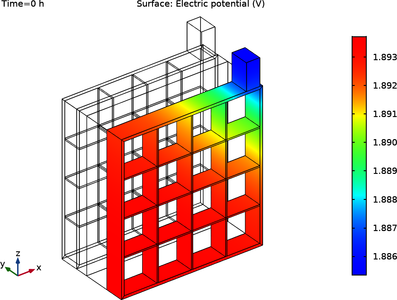
This 3D model example demonstrates the use of the Lead-Acid Battery interface for modeling current distribution in full cell employing a lead-acid battery chemistry. The lead acid battery chemistry uses PbO2 as the positive porous electrode and Pb as the negative porous electrode and ... Per saperne di più

This example treats a pulmonary artery stenosis as a porous medium and demonstrates how to set up a model that combines free and porous media flow of a non-Newtonian fluid. The non-Newtonian behavior of blood is modeled using the Carreau model. Per saperne di più
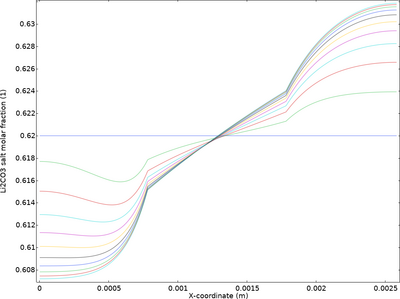
This tutorial shows how to model transport of the individual ions in a salt melt comprising two binary salts, where the transport equations are defined using concentrated solution theory. The example model defines a molten carbonate fuel cell (or electrolyzer), with a 1D-model geometry ... Per saperne di più

1D model of a thermal energy storage (TES) system consisting of a packed bed of pellets. Three approaches for heat transfer in porous media are compared: A one-equation local thermal equilibrium (LTE) model A two-equations local thermal nonequilibrium (LTNE) model A multiscale ... Per saperne di più


