
La Galleria delle Applicazioni raccoglie un'ampia varietà di tutorial e di app dimostrative realizzati con COMSOL Multiphysics in diversi ambiti applicativi, inclusi quelli elettrico, meccanico, fluidico e chimico. E' possibile scaricare i file dei modelli e delle app demo pronti all'uso e le istruzioni step-by-step per costruirli, e utilizzarli come punto di partenza per le proprie simulazioni.
Lo strumento di Ricerca Rapida permette di trovare i modelli che si riferiscono alla propria area di interesse.
Si noti che molti degli esempi qui presentati sono accessibili anche tramite le Librerie delle Applicazioni incorporate nel software COMSOL Multiphysics® e disponibili dal menu File.
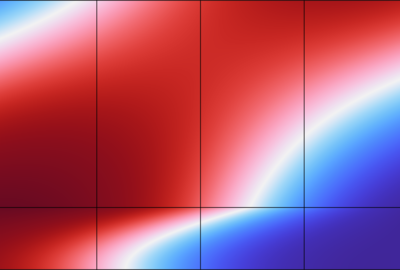
This tutorial investigates the acoustic properties of a porous layer made of glass wool. The porous material has transverse isotropic properties and is modeled with the full anisotropic poroelastic material model. Per saperne di più

Transport through porous structures is usually treated using simplified homogeneous models with effective transport properties. This is in most cases a necessity, since the typical dimensions of the pores and particles making up the porous structure are several orders of magnitude ... Per saperne di più
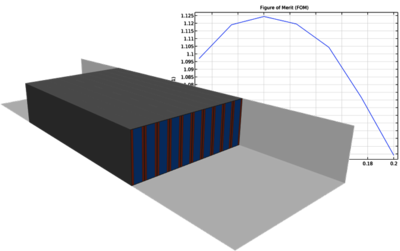
This example computes the effectiveness of a porous microchannel heat sink over a conventional microchannel heat sink. The model is fully parameterized. A parameter study on the thickness of the porous substrate is used to determine the optimal configuration. Per saperne di più
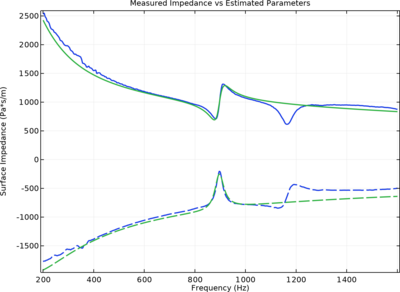
This app is an example of how the poroelastic properties of a porous material can be determined based on measurement done with an impedance tube and parameter estimation. Being able to determine the characteristics of a porous material from a single and simple measurement opens the door ... Per saperne di più
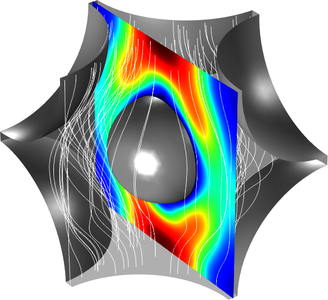
This example shows how to estimate the permeability of a porous material by creating a detailed fluid flow model in a small unit cell. The result of the model is a lumped permeability of the material, which can be used in homogenized models using Darcy's law or the Brinkman equations. ... Per saperne di più
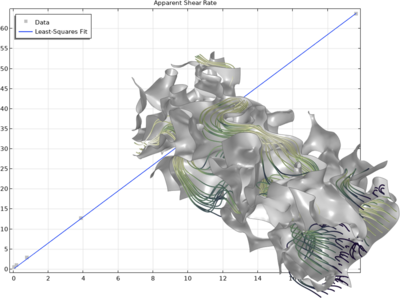
Non-Newtonian fluids have complex flow characteristics that vary with shear rate, making their behavior in porous materials difficult to predict. Pore scale modeling captures these flow patterns at a microscopic level, helping derive properties for macroscale use. This model ... Per saperne di più
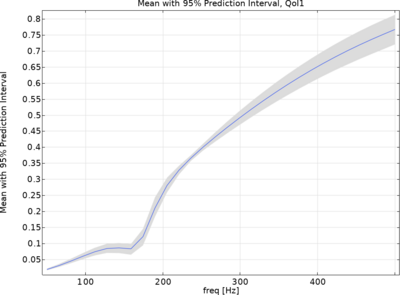
It can in many cases be difficult to get accurate material properties for porous materials. Measuring the properties to high precision can involve lengthy measurements using different techniques. It can therefore be interesting to understand how uncertainties in different material ... Per saperne di più
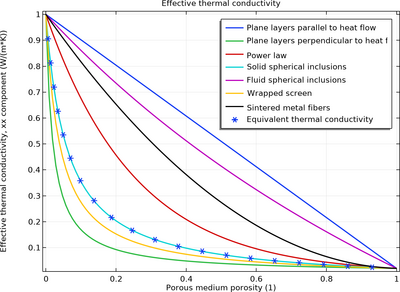
This tutorial presents the averaging models available within the Heat Transfer in Porous Media interface, used to compute the effective thermal conductivity, when the local thermal equilibrium assumption is made. The models are compared for porosities ranging from 0 to 1, and for a ... Per saperne di più
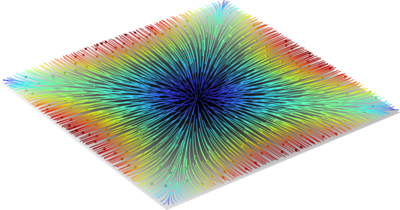
This example describes how to simulate the flow of a thin film of fluid in the gap between two rectangular plates, one of them with a porous facing, when the fluid is squeezed as a consequence of the relative motion between the plates. The model accounts for the ingress and egress of ... Per saperne di più
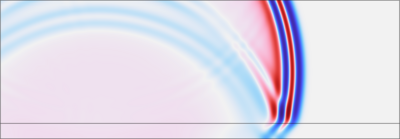
This tutorial studies the propagation of sound in the presence of a porous absorber in the time domain. It demonstrates how to model a porous absorber using the local and extended reacting approximations and compares the two approaches for absorbers of various thickness. The dissipative ... Per saperne di più


