
La Galleria delle Applicazioni raccoglie un'ampia varietà di tutorial e di app dimostrative realizzati con COMSOL Multiphysics in diversi ambiti applicativi, inclusi quelli elettrico, meccanico, fluidico e chimico. E' possibile scaricare i file dei modelli e delle app demo pronti all'uso e le istruzioni step-by-step per costruirli, e utilizzarli come punto di partenza per le proprie simulazioni.
Lo strumento di Ricerca Rapida permette di trovare i modelli che si riferiscono alla propria area di interesse.
Si noti che molti degli esempi qui presentati sono accessibili anche tramite le Librerie delle Applicazioni incorporate nel software COMSOL Multiphysics® e disponibili dal menu File.
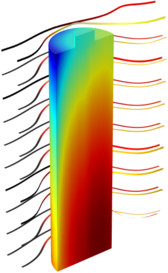
This example simulates the heat profile in an air-cooled cylindrical battery in 3d. The battery is placed in a matrix in a battery pack. The thermal model is coupled to a 1d-battery model that is used to generate a heat source in the active battery material. The model requires the ... Per saperne di più

This tutorial model demonstrates how to use the Combined Inductively/DC Discharge interface to simulate the plasma generated in a pulsed arc. This modeling technique is useful for a large range of industrial applications including cutting, welding, spraying, waste destruction, and ... Per saperne di più
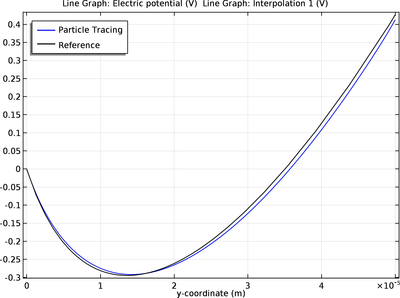
When electrons are emitted from a heated cathode in a plane parallel vacuum diode, they contribute to the space charge density in the diode, which in turn affects the electric potential distribution. If the potential difference between the cathode and the anode is not sufficiently large, ... Per saperne di più

The underlying physics of a capacitively coupled plasma is rather complicated, even for rather simple geometric configurations and plasma chemistries. This model benchmarks the Capacitively Coupled Plasma physics interface against many different codes. Per saperne di più
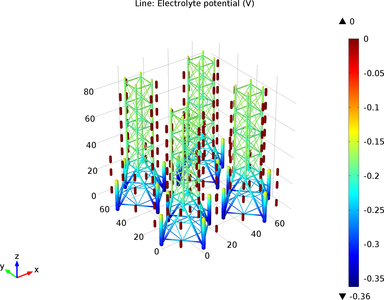
This example extends the corrosion protection system analysis of the single oil platform example by modeling the influence of multiple oil platforms placed in an array. The use of the Current Distribution on Edges, BEM interface significantly reduces the problem size and computational ... Per saperne di più

This tutorial digs deeper into the investigation of rate capability in a battery and shows how the Lithium-Ion Battery interface is an excellent modeling tool for doing this. The rate capability is studied in terms of polarization (voltage loss) or the internal resistance causing this ... Per saperne di più
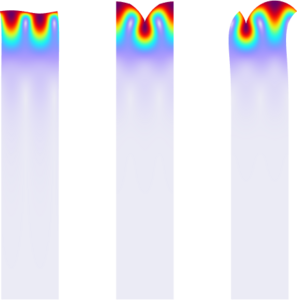
FEM simulation can be used to obtain a SAW velocity and some related parameters (squared electromechanical coupling coefficient, reflectivity, etc.) for different typical configurations. Such parameters are input data for various analytical and semi-analytical methods of SAW device ... Per saperne di più
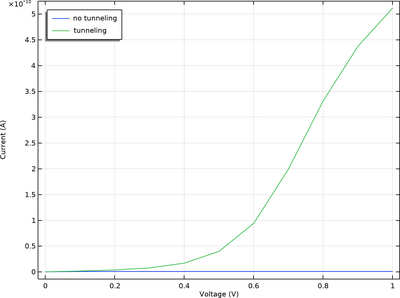
This model shows how to model a simple Metal–Insulator–Metal (MIM) diode. The two metal electrodes are defined on each side using the Metal Contact feature. Two studies were performed: one without quantum tunneling across the potential barrier and the other including it, using the WKB ... Per saperne di più
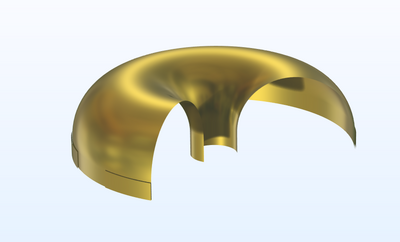
This tutorial demonstrates how to model a gyroscope based on the birdbath resonator gyroscope (BRG) design. The BRG is a type of Coriolis vibratory gyroscope (CVG) invented at the University of Michigan as a navigation-grade gyroscope in the mm-scale. This tutorial shows how the ... Per saperne di più

This model, dealing with the current and potential distribution around one pair of electrodes, demonstrates how to synchronize and modify geometry in SOLIDWORKS® by using the LiveLink™ interface with a parametric sweep. Per saperne di più


