
La Galleria delle Applicazioni raccoglie un'ampia varietà di tutorial e di app dimostrative realizzati con COMSOL Multiphysics in diversi ambiti applicativi, inclusi quelli elettrico, meccanico, fluidico e chimico. E' possibile scaricare i file dei modelli e delle app demo pronti all'uso e le istruzioni step-by-step per costruirli, e utilizzarli come punto di partenza per le proprie simulazioni.
Lo strumento di Ricerca Rapida permette di trovare i modelli che si riferiscono alla propria area di interesse.
Si noti che molti degli esempi qui presentati sono accessibili anche tramite le Librerie delle Applicazioni incorporate nel software COMSOL Multiphysics® e disponibili dal menu File.
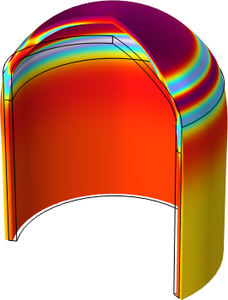
A thin-walled container made of rolled steel is subjected to an internal overpressure. As an effect of the manufacturing method, one of the three material principal directions — the out-of- plane direction — has a higher yield stress than the other two. Hill’s orthotropic plasticity is ... Per saperne di più
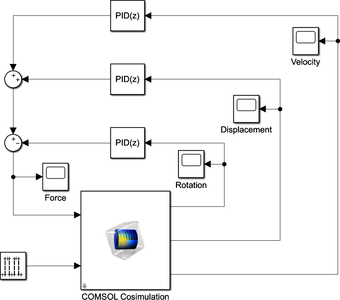
This model shows how to control the position of the base of an inverted pendulum to keep it vertical. The control is performed using a PID controller in Simulink®. The position of the base is constrained within specified limits, and an external force is applied at the base to keep it ... Per saperne di più
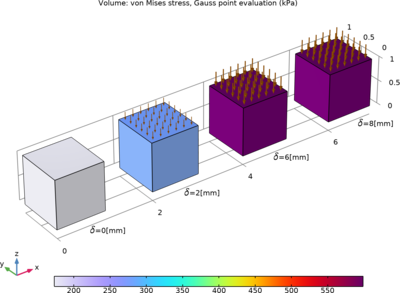
This model shows how to set up a uniaxial compression test on a prestressed soil sample. Due to uniaxial compression and simple initial stress values, it is possible to determine the vertical yield stress analytically. The soil sample is modeled with soil plasticity and the Mohr–Coulomb ... Per saperne di più
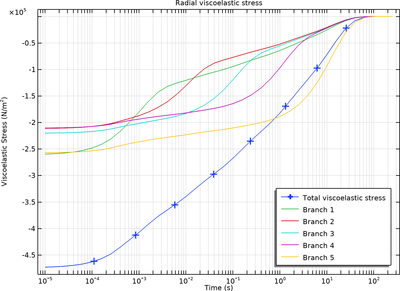
Anisotropic hyperelastic materials are used for modeling collagenous soft tissue in arterial walls. The Arterial Wall Mechanics application describes a section of an artery based on the Holzapfel–Gasser-Ogden hyperelastic material model. In this example the dynamic behavior of the artery ... Per saperne di più
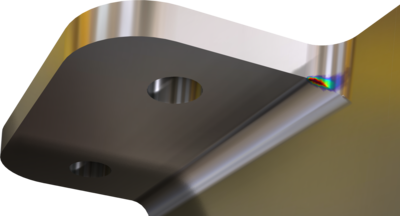
This example shows how to perform a fatigue analysis of a structure subjected to harmonic vibrations. The loading is applied at the attachments of the structure, and a frequency sweep is performed to compute the fatigue usage. Per saperne di più
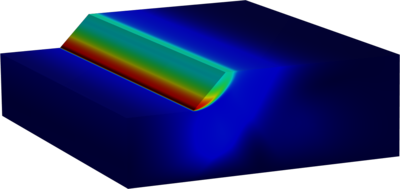
The strength reduction technique is a tool to find the factor of safety (FOS) in geotechnical problems, particularly in slope stability analyses. To determine the factor of safety of the slope, the strength properties in the Mohr–Coulomb model are gradually reduced until failure occurs. ... Per saperne di più
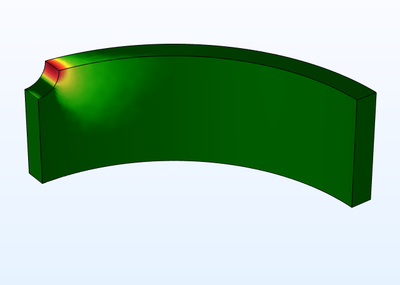
A load carrying component of a structure is subjected to multi-axial cyclic loading during which localized yielding of the material occurs. In this model you perform a low cycle fatigue analysis of the part based on the Smith-Watson-Topper (SWT) model. Due to localized yielding, you ... Per saperne di più
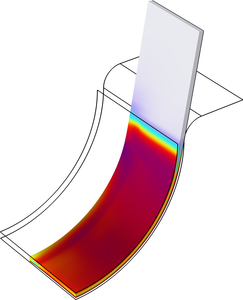
This example benchmarks a NAFEMS validation model of a friction contact problem with an elastoplastic material model. A thin metal sheet is forced into a die by a punch. Both the compressing displacement and the release of the punch are modeled in order to compute the forming angle (at ... Per saperne di più
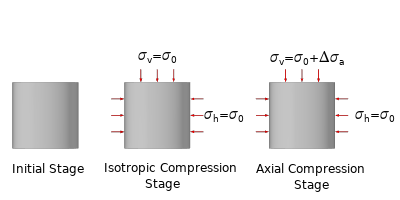
In this example, triaxial and oedometer tests are simulated using the Hardening Soil material model. Both tests exhibit a hyperbolic stress–strain relationship. For the triaxial test, it is confirmed that the axial stress approaches the analytical failure stress asymptotically. In the ... Per saperne di più
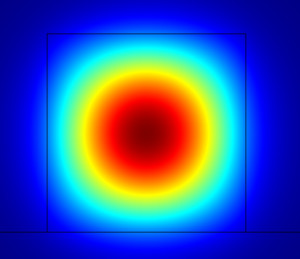
Planar photonic waveguides in silica (SiO2) have great potential for use in wavelength routing applications. The major problem with this type of waveguide is birefringence. Anisotropic refractive indices result in fundamental mode splitting and pulse broadening. The goal is to minimize ... Per saperne di più


