
La Galleria delle Applicazioni raccoglie un'ampia varietà di tutorial e di app dimostrative realizzati con COMSOL Multiphysics in diversi ambiti applicativi, inclusi quelli elettrico, meccanico, fluidico e chimico. E' possibile scaricare i file dei modelli e delle app demo pronti all'uso e le istruzioni step-by-step per costruirli, e utilizzarli come punto di partenza per le proprie simulazioni.
Lo strumento di Ricerca Rapida permette di trovare i modelli che si riferiscono alla propria area di interesse.
Si noti che molti degli esempi qui presentati sono accessibili anche tramite le Librerie delle Applicazioni incorporate nel software COMSOL Multiphysics® e disponibili dal menu File.

This is a tutorial model that illustrates the use of the scattered field formulation in acoustics. A solid object (here an ellipsoid) is hit by an incident plane wave field (background pressure field). The model solves for the scattered field. The model uses a PML and a far-field ... Per saperne di più
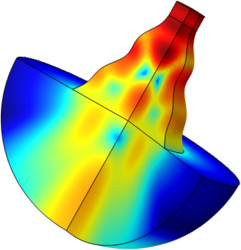
A plane-wave mode feeds an axisymmetric horn radiating from an infinite baffle toward an open half space. The radius of the waveguide attached to the horn throat is assumed to be fixed, as well as the depth of the horn and the size of the horn mouth attached to the baffle. By varying the ... Per saperne di più
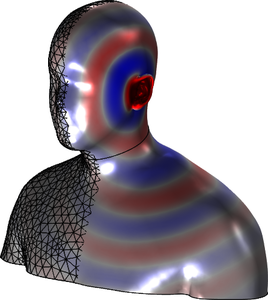
This tutorial model shows how to import a 3D scanned geometry of a human head and torso and compute the head related transfer function (HRTF). The scan is imported as a .stl file and converted into a COMSOL geometry. The HRTF is computed using the reciprocity principle, locating the ... Per saperne di più

This model demonstrates how to use the Control Function feature to perform shape optimization on a rectangular horn for an improved on axis response. The results of the initial design are exported to a new component via a Filter dataset. Further, the off-axis spatial response is improved ... Per saperne di più
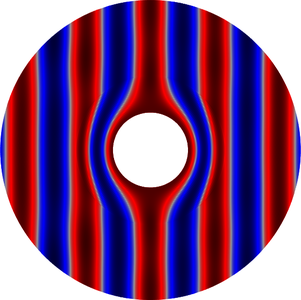
This example demonstrates how to use a background field in a sound scattering problem. The application is an acoustic invisibility cloak made of a metamaterial. Two different types of metamaterials are used, one using an anisotropic acoustic material with varying properties and one using ... Per saperne di più
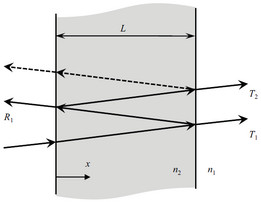
This is an example of a Fabry-Perot cavity, the simplest optical resonator structure. It is a classical problem in optics and photonics. Two methods are shown for computing the Q-factor. The losses in this model are purely via radiation away from the resonator. Per saperne di più
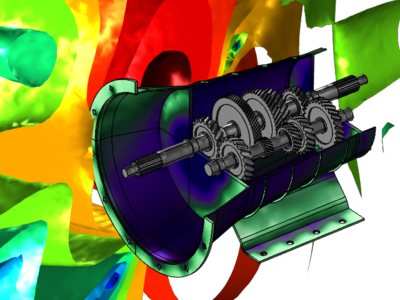
A gearbox is used to transfer power from an engine to its associated wheels or cogs, which can result in radiating noise to the surroundings. This is due to the transmission of undesired lateral and axial forces on the bearings and housing, while transmitting power from one shaft to the ... Per saperne di più
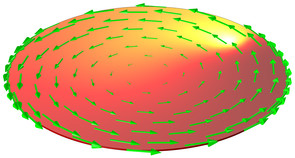
A silicon wafer is heated up by a laser that moves radially in and out over time. In addition, the wafer itself is rotated on its stage. The incident heat flux from the laser is modeled as a spatially distributed heat source on the surface. The transient thermal response of the wafer is ... Per saperne di più

Liquid or gas acoustics coupled to structural objects such as membranes, plates or solids are important applications in many engineering fields. This model is a general demonstration of an acoustic fluid phenomenon in 3D that is coupled to a solid object. The walls of the solid object ... Per saperne di più
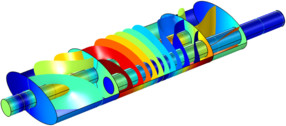
This model simulates the pressure wave propagation in a muffler for a combustion engine. It uses a general approach for analysis of damping of the propagation of harmonic pressure waves. The model is solved in the frequency domain and provides efficient damping in a frequency range of ... Per saperne di più


