
La Galleria delle Applicazioni raccoglie un'ampia varietà di tutorial e di app dimostrative realizzati con COMSOL Multiphysics in diversi ambiti applicativi, inclusi quelli elettrico, meccanico, fluidico e chimico. E' possibile scaricare i file dei modelli e delle app demo pronti all'uso e le istruzioni step-by-step per costruirli, e utilizzarli come punto di partenza per le proprie simulazioni.
Lo strumento di Ricerca Rapida permette di trovare i modelli che si riferiscono alla propria area di interesse.
Si noti che molti degli esempi qui presentati sono accessibili anche tramite le Librerie delle Applicazioni incorporate nel software COMSOL Multiphysics® e disponibili dal menu File.
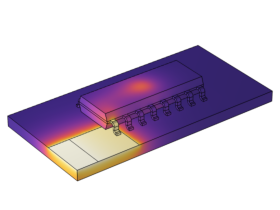
All integrated circuits (ICs) — especially high-speed devices — produce heat. In today’s dense electronic system layouts, heat sources are many times placed close to heat-sensitive ICs. Designers of printed circuit boards often need to consider the relative placement of heat ... Per saperne di più
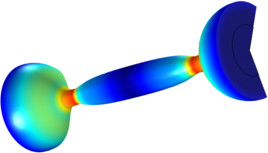
The Marangoni effect results in a slip velocity in the tangential direction on a fluid/fluid interface due to gradients in the surface tension coefficient. When the surface tension coefficient is constant, a two-fluid system may exist in static equilibrium. This is because the surface ... Per saperne di più

When producing glass, the glass melt is cooled down through radiation to form the final shape, subjecting it to stresses. Numerical treatment of radiative heat transfer, using the Radiative Transfer Equation (RTE), helps to optimize this process. COMSOL Multiphysics provides three ... Per saperne di più
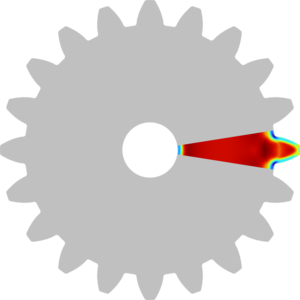
This model shows how to simulate carburization and quenching of a steel gear. Diffusion of carbon into the surface of the gear affects the onset of martensitic transformation. Residual stresses are computed, and it is shown that high residual compressive stresses appear at the root of ... Per saperne di più

This model shows how to use simulations to predict power numbers with Power Law fluids in a mixer. It simulates the behavior of flow in a flat bottom tank with a single four-blade pitched impeller. The flow was modeled as laminar and the frozen rotor approach was used to solve the ... Per saperne di più
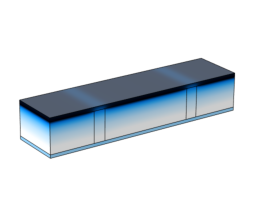
This 2D stationary model computes heat and moisture transport in a wall composed of different hygroscopic materials. A comparison with the Glaser method is given for the temperature and relative humidity solutions. The effect of the use of a vapor barrier is also investigated. Per saperne di più

This example models the flow in a 90-degree pipe elbow. The flow is simulated using the k-omega turbulence model. The result is compared to engineering correlations. Per saperne di più
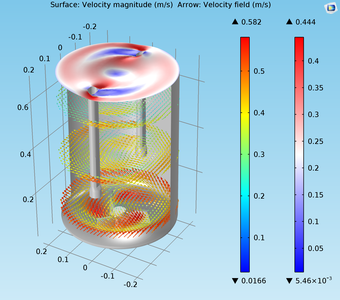
This example of turbulent flow in a partially baffled turbulent mixer shows how to set up The Rotating Machinery, Turbulent Flow interfaces from the Mixer Module with free surface and stationary free surface features. Both frozen rotor and time-dependent simulations are performed and ... Per saperne di più

This is a conceptual model illustrating how to couple fluid-structure interaction, heat transfer, and thermal expansion. A bimetallic strip in an air channel is heated so that it bends. After some time, an airflow with an inlet temperature which varies in time is introduced. As a ... Per saperne di più
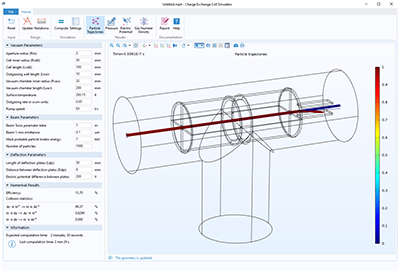
A charge exchange cell consists of a region of gas at an elevated pressure within a vacuum chamber. When an ion beam interacts with the higher-density gas, the ions undergo charge exchange reactions with the gas which then create energetic neutral particles. It is likely that only a ... Per saperne di più


