
La Galleria delle Applicazioni raccoglie un'ampia varietà di tutorial e di app dimostrative realizzati con COMSOL Multiphysics in diversi ambiti applicativi, inclusi quelli elettrico, meccanico, fluidico e chimico. E' possibile scaricare i file dei modelli e delle app demo pronti all'uso e le istruzioni step-by-step per costruirli, e utilizzarli come punto di partenza per le proprie simulazioni.
Lo strumento di Ricerca Rapida permette di trovare i modelli che si riferiscono alla propria area di interesse.
Si noti che molti degli esempi qui presentati sono accessibili anche tramite le Librerie delle Applicazioni incorporate nel software COMSOL Multiphysics® e disponibili dal menu File.
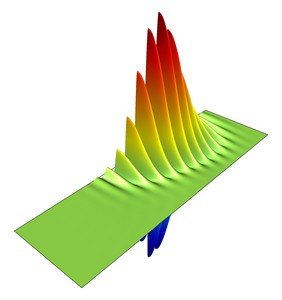
It is possible to generate harmonics that are multiples of the frequency of laser light by using nonlinear optical materials. This model demonstrates second harmonic generation using transient wave simulation and nonlinear material properties. A YAG (lambda=1.06 micron) laser beam is ... Per saperne di più

A spiral slot antenna provides a conformal design and can be used for communication, sensing, tracking, positioning, and many applications in different microwave frequency bands due to its wide-band frequency response. This model shows how to build a spiral geometry using parametric ... Per saperne di più
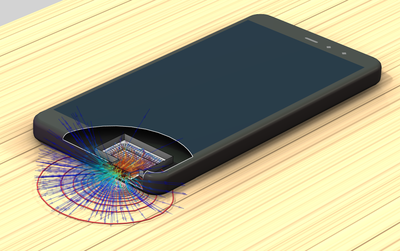
This tutorial model shows how to model a microspeaker located in a smart phone including the radiation through and interaction with the acoustic port that connects to the exterior. The model demonstrates a linear frequency domain analysis as well as a nonlinear time domain analysis. A ... Per saperne di più
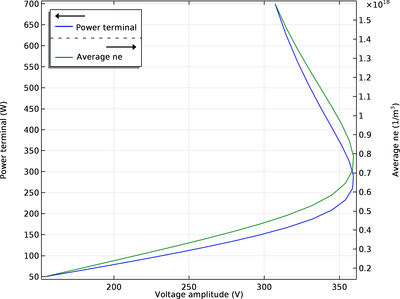
Capacitively coupled RF discharges can operate in two distinct regimes depending on the discharge power. In the low power regime, known as the alpha regime, the electric field oscillation is responsible to heat and create electrons. In the high power regime, known as gamma regime, the ... Per saperne di più
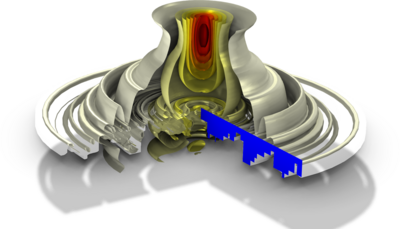
This model demonstrates how to use topology optimization with milling constraints to design a metalens that focuses a single wavelength to a point. This involves transferring the optimized results to another component so the result can be verified using an explicit geometry ... Per saperne di più
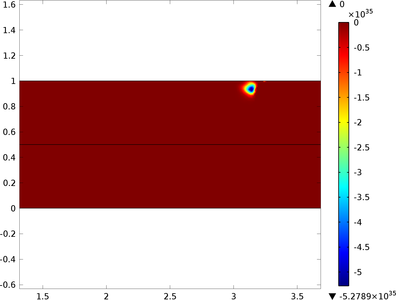
MOSFETs typically operate in three regimes depending on the drain-source voltage for a given gate voltage. Initially the current-voltage relation is linear, this is the Ohmic region. As the drain-source voltage increases the extracted current begins to saturate, this is the saturation ... Per saperne di più
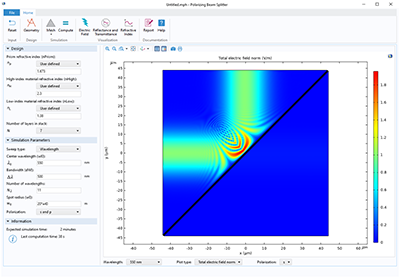
A Gaussian beam is incident on a 45-degree thin-film stack embedded in glass material prisms. The thin-film stack is designed from alternating high and low refractive index materials. The wave will be refracted at the Brewster angle at each internal interface. Thus, mainly p-polarized ... Per saperne di più
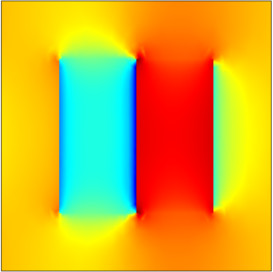
Magnetotellurics is a method for estimating the resistivity profile of the Earth's subsurface using the natural electromagnetic source provided by the ionosphere. This model was defined by Zhdanov et al. in a study published in 1997. In this article, various scientific groups compared ... Per saperne di più


