
La Galleria delle Applicazioni raccoglie un'ampia varietà di tutorial e di app dimostrative realizzati con COMSOL Multiphysics in diversi ambiti applicativi, inclusi quelli elettrico, meccanico, fluidico e chimico. E' possibile scaricare i file dei modelli e delle app demo pronti all'uso e le istruzioni step-by-step per costruirli, e utilizzarli come punto di partenza per le proprie simulazioni.
Lo strumento di Ricerca Rapida permette di trovare i modelli che si riferiscono alla propria area di interesse.
Si noti che molti degli esempi qui presentati sono accessibili anche tramite le Librerie delle Applicazioni incorporate nel software COMSOL Multiphysics® e disponibili dal menu File.

Every electrical device has some resistance. That is, when a voltage difference is applied across any two terminals of the device, there will be a directly proportional current flow. This model demonstrates how to compute the resistance of a short section of copper wire. The convergence ... Per saperne di più
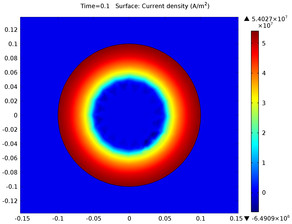
Superconducting materials have zero resistivity up to a certain critical current density, above which the resistivity increases rapidly. To model such a material, this example uses the Magnetic Field Formulation physics interface. The model was based on a suggestion by Dr. Roberto ... Per saperne di più
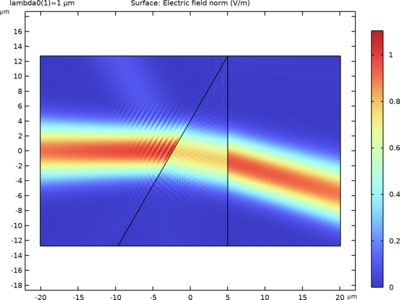
This model illustrates the refraction of light while passing through an optical prism using s– and p–polarized incident Gaussian beams. The prism boundaries are coated with anti–reflection coatings. It also calculates the reflectance and transmittance to analyze the performance of anti ... Per saperne di più
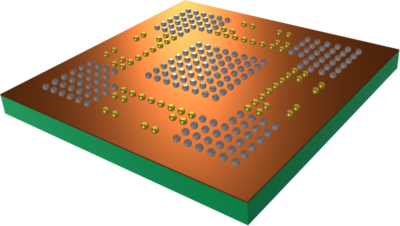
The ball grid array (BGA) technology is a surface-mount technology widely used in electronic packaging. Usually, there are two types of solder balls considered in the array, including the functional balls that are required for electric connections and the support balls that are used only ... Per saperne di più
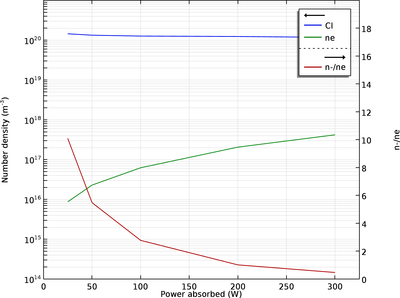
Plasma discharges containing chlorine are commonly used to etch semiconductors and metals in microelectronics fabrication. This tutorial model studies chlorine plasma discharges using a global (volume-averaged) diffusion model. Global diffusion models can run simulations in a fraction ... Per saperne di più
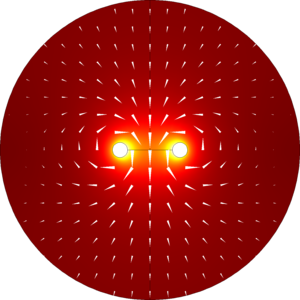
A parallel wire transmission line is composed of two conducting wires in a dielectric such as air. The fields around such a transmission line are not directly confined by the conductors, and extend to infinity, although they drop off in rapidly away from the wires. This model ... Per saperne di più

This benchmark model computes the valence band structure of an unstrained and a strained bulk GaN wurtzite crystal, as a tutorial for users who wish to set up multiple wave function components with the Schrödinger Equation interface. The model follows the formulation given in the ... Per saperne di più

This tutorial models an ICP reactor by solving plasma fluid type equations fully coupled with the homogeneous and time-independent electron Boltzmann equation in the classical two-term approximation. The approximated Boltzmann equation is solved for each position of space and is coupled ... Per saperne di più


