
La Galleria delle Applicazioni raccoglie un'ampia varietà di tutorial e di app dimostrative realizzati con COMSOL Multiphysics in diversi ambiti applicativi, inclusi quelli elettrico, meccanico, fluidico e chimico. E' possibile scaricare i file dei modelli e delle app demo pronti all'uso e le istruzioni step-by-step per costruirli, e utilizzarli come punto di partenza per le proprie simulazioni.
Lo strumento di Ricerca Rapida permette di trovare i modelli che si riferiscono alla propria area di interesse.
Si noti che molti degli esempi qui presentati sono accessibili anche tramite le Librerie delle Applicazioni incorporate nel software COMSOL Multiphysics® e disponibili dal menu File.
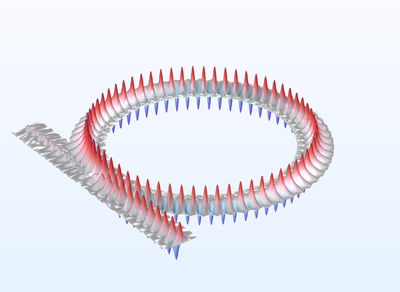
This example calculates the spectral properties of a 3D optical ring resonator. The model demonstrates how to use parts from the Wave Optics Parts Library and how to setup the Field Continuity boundary condition at boundaries, where there is a jump in the predefined phase approximation. Per saperne di più

This tutorial demonstrates the operation of a gyroscope based on design provided by Dr. James Ransley at Veryst Engineering, LLC. The model uses the Electromechanics coupling with the mixed finite element formulation in the Electrostatics interface. Per saperne di più

Users of consumer electronics with radiating devices are exposed to radio frequency (RF) emission. The amount of exposure is defined as the specific absorption rate (SAR). That is, the SAR value represents the radio frequency (RF) energy rate absorbed by a body. This model computes local ... Per saperne di più
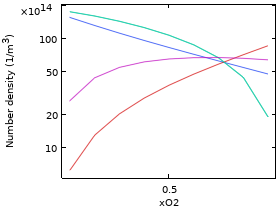
This tutorial model solves for an inductively coupled plasma reactor in a mixture of argon/oxygen. The model computes the fluid flow and gas heating. Important aspects and strategies for modeling electronegative discharges are discussed. Per saperne di più
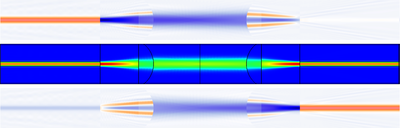
Focusing a laser beam onto the tip of a single mode fiber is a common way to couple light. To achieve good coupling efficiency, the spatial mode of the light field has to match the spatial mode of the fiber. In this model, we use the beam envelopes method to compute a small free-space ... Per saperne di più
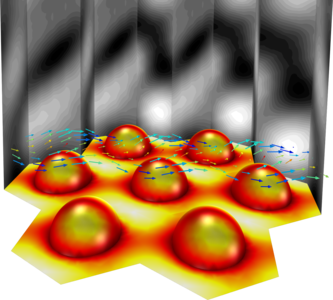
A plane wave is incident on a reflecting hexagonal grating. The grating cell consists of a protruding semisphere. The scattering coefficients for the different diffraction orders are calculated for a few different wavelengths. Per saperne di più

In its simplest form, an optical ring resonator consists of a straight waveguide and a ring waveguide. The waveguides are placed close to each other, making the light affect each between the two structures. If the propagation length around the ring is an integral number of wavelengths, ... Per saperne di più
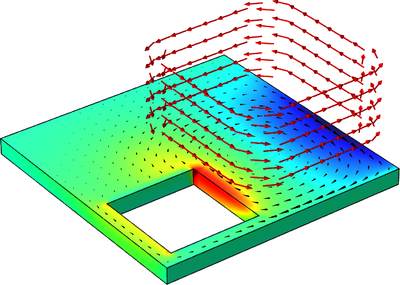
This model solves the Testing Electromagnetic Analysis Methods (TEAM) problem 7, “Asymmetrical Conductor with a Hole”—a benchmark problem concerning the calculation of eddy currents and magnetic fields produced when an aluminum conductor is placed asymmetrically above a multi-turn coil ... Per saperne di più


