
La Galleria delle Applicazioni raccoglie un'ampia varietà di tutorial e di app dimostrative realizzati con COMSOL Multiphysics in diversi ambiti applicativi, inclusi quelli elettrico, meccanico, fluidico e chimico. E' possibile scaricare i file dei modelli e delle app demo pronti all'uso e le istruzioni step-by-step per costruirli, e utilizzarli come punto di partenza per le proprie simulazioni.
Lo strumento di Ricerca Rapida permette di trovare i modelli che si riferiscono alla propria area di interesse.
Si noti che molti degli esempi qui presentati sono accessibili anche tramite le Librerie delle Applicazioni incorporate nel software COMSOL Multiphysics® e disponibili dal menu File.
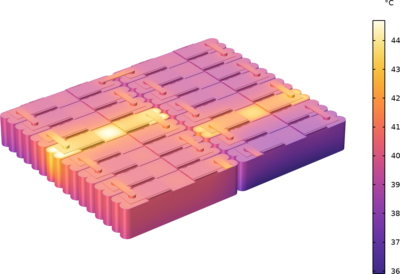
This example models the temperature profile in a liquid-cooled prismatic battery pack during a high-rate charge. The pack consists of 16 prismatic battery cells connected by busbars, placed on an aluminum plate containing four cooling channels. The battery pack is assumed to have two ... Per saperne di più
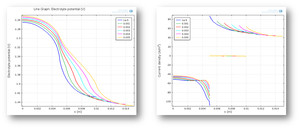
The use of Aluminum (Al) isolator is a commonly employed mitigation strategy for galvanic corrosion between magnesium alloy (Mg) and mild steel (MS). The present model demonstrates the effect of Al isolator thickness on galvanic corrosion severity using a parametric study. The electrode ... Per saperne di più
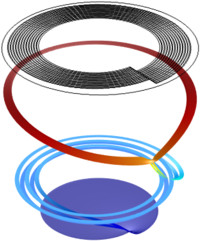
Due to the large differences in length scales in a lithium-ion battery, with the thickness of the different layers typically being several orders of magnitude smaller than the extension in the sheet direction, a lithium-ion battery is often well represented by a one-dimensional model. ... Per saperne di più
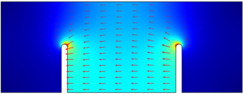
This example treats the modeling of electroosmotic flow in porous media. The system consists of a compartment of sintered porous material and two electrodes that generate an electric field. The cell combines pressure and electroosmotic driven flow. The equations that are solved are the ... Per saperne di più
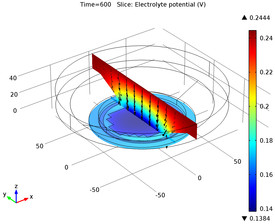
This example models time-dependent copper deposition on a resistive wafer in a cupplater reactor. As the deposited layer builds up, the resistive losses of the deposited layer decreases. The benefit of using a current thief for a more uniform deposit is demonstrated. Per saperne di più
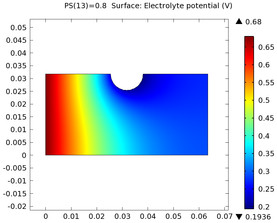
This example models cathodic protection of a steel reinforcing bar in concrete. Three different electrochemical reactions are considered on the steel surface. Charge and oxygen transport are modeled in the concrete domain, where the electrolyte conductivity and oxygen diffusivity depend ... Per saperne di più
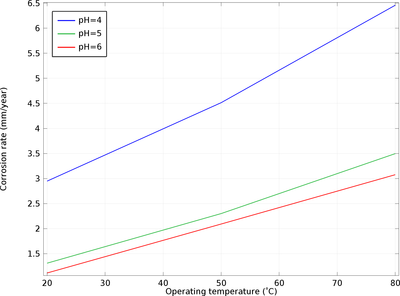
Carbon dioxide in aqueous solution is highly corrosive and can cause significant damage to steel designs. Such conditions arise in pipes used in a variety of applications, especially within the petrochemical industry. In this tutorial example, turbulent flows consisting of carbon ... Per saperne di più
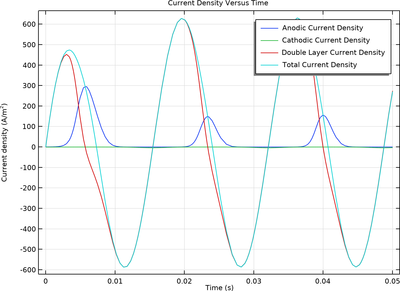
Corrosion induced due to alternating current (AC) is evident in the oil and gas industry, particularly when a pipeline is in close proximity to the high power transmission lines. A numerical model presented here first evaluates the effect of direct current (DC) applied potential on ... Per saperne di più


