
La Galleria delle Applicazioni raccoglie un'ampia varietà di tutorial e di app dimostrative realizzati con COMSOL Multiphysics in diversi ambiti applicativi, inclusi quelli elettrico, meccanico, fluidico e chimico. E' possibile scaricare i file dei modelli e delle app demo pronti all'uso e le istruzioni step-by-step per costruirli, e utilizzarli come punto di partenza per le proprie simulazioni.
Lo strumento di Ricerca Rapida permette di trovare i modelli che si riferiscono alla propria area di interesse.
Si noti che molti degli esempi qui presentati sono accessibili anche tramite le Librerie delle Applicazioni incorporate nel software COMSOL Multiphysics® e disponibili dal menu File.

This model simulates atmospheric galvanic corrosion of a busbar, which includes a copper flange, an aluminum alloy flange in contact with a zinc nut and bolt. The Secondary Current Distribution interface is used to solve for the electric potential in electrode domain and Current ... Per saperne di più

This tutorial digs deeper into the investigation of rate capability in a battery and shows how the Lithium-Ion Battery interface is an excellent modeling tool for doing this. The rate capability is studied in terms of polarization (voltage loss) or the internal resistance causing this ... Per saperne di più
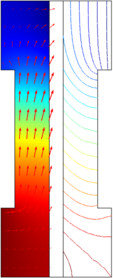
This example focuses on the species transport within the gas diffusion layers (GDLs) of a proton exchange membrane (PEM) fuel cell. The geometry models a cell with two adjacent flow channels of different pressures, a situation that may occur in a cell with serpentine flow channels, or in ... Per saperne di più
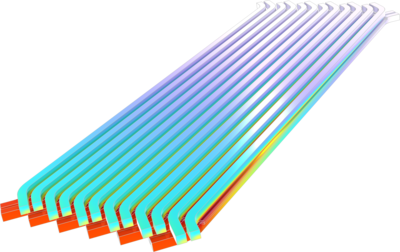
In a polymer electrolyte membrane fuel cell (PEMFC), water is produced at the cathode. The cell is also fed with water vapor via the inlet gas streams, in order to keep the polymer electrolyte membrane humidified. If the water partial pressure in the gas phase exceeds the vapor ... Per saperne di più
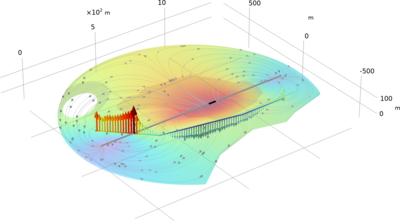
Light rail transit (LRT) systems often utilize DC power for train propulsion. In these systems the potential gradients in the rails may induce stray currents, which corrode adjacent metallic structures. In this example, the Cathodic Protection interface, using Edge Electrode nodes, is ... Per saperne di più
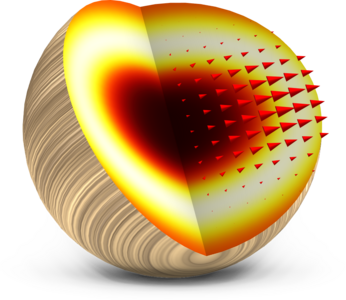
The pyrolysis of a centimeter-sized wood particle presents a fully coupled multiphysics problem with mass transfer, fluid flow, and heat transfer. This example model consists of two parts. The first part demonstrates how to set up a model describing the pyrolysis of a porous, ... Per saperne di più
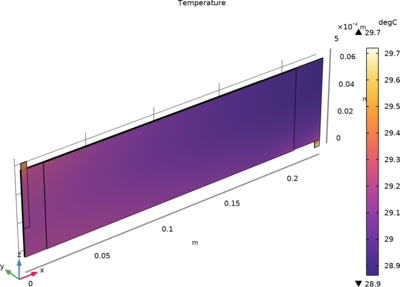
This example replicates the results of the Jelly Roll tutorial example using a flattened representation of the wound spiral-based geometry. See that model entry for details on the background, original geometry, materials, and the general physics setup. Mapping the original problem to a ... Per saperne di più
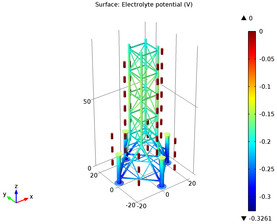
Steel structures immersed in seawater can be protected from corrosion through cathodic protection. This protection can be achieved by an impressed external current or by using sacrificial anodes. The use of sacrificial anodes is often preferred due to its simplicity. This example models ... Per saperne di più


