
La Galleria delle Applicazioni raccoglie un'ampia varietà di tutorial e di app dimostrative realizzati con COMSOL Multiphysics in diversi ambiti applicativi, inclusi quelli elettrico, meccanico, fluidico e chimico. E' possibile scaricare i file dei modelli e delle app demo pronti all'uso e le istruzioni step-by-step per costruirli, e utilizzarli come punto di partenza per le proprie simulazioni.
Lo strumento di Ricerca Rapida permette di trovare i modelli che si riferiscono alla propria area di interesse.
Si noti che molti degli esempi qui presentati sono accessibili anche tramite le Librerie delle Applicazioni incorporate nel software COMSOL Multiphysics® e disponibili dal menu File.
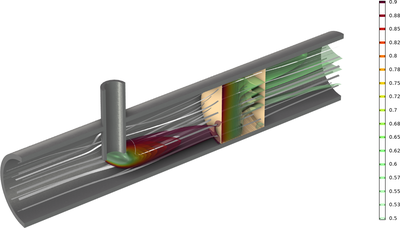
Modeling packed beds, monolithic reactors, and other catalytic heterogeneous reactors is substantially simplified with the Reacting Flow in Porous Media multiphysics interface. This defines the diffusion, convection, migration, and reaction of chemical species for porous media flow ... Per saperne di più

An important step in brewing beer is the fermentation process. Here, alcohol is formed together with various flavor substances from sugars in the presence of yeast. The initial sugar content, temperature, and yeast type dictate how the fermentation proceeds. In this example, the ... Per saperne di più
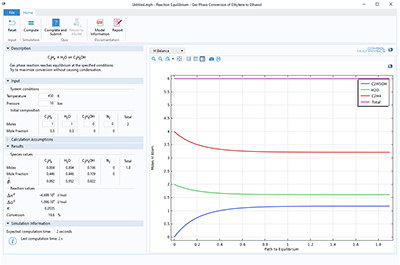
This app demonstrates the following: How an app can be used as a teaching tool An 8 question multiple choice quiz where the answers can be sent to the grader by email This app calculates the equilibrium compositions in gas phase conversion of ethylene to ethanol. It allows you to ... Per saperne di più
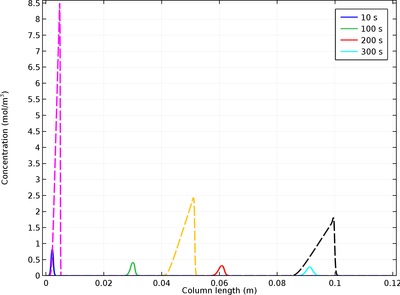
High-performance liquid chromatography (HPLC) is a common method of separating, identifying, and quantifying each chemical compound in a mixture. HPLC is found in the pharmaceutical, biotech, and food industries. The Liquid Chromatography app simulates the separation of two species ... Per saperne di più
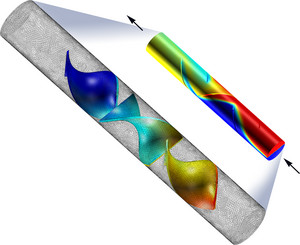
In static mixers, also called motionless or in-line mixers, a fluid is pumped through a pipe containing stationary blades. This mixing technique is particularly well suited for laminar flow mixing because it generates only small pressure losses in this flow regime. This example studies ... Per saperne di più
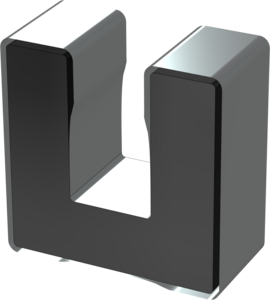
This model analyzed the ALD deposition process of alumina film on the surface of a U-shaped structure. In this process, gaseous precursors are sequentially introduced to the reaction chamber and sequentially undergo a series of adsorption and chemical reactions on the surface. The ... Per saperne di più
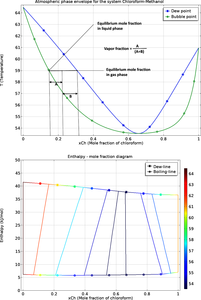
This is a demonstration of how to use the thermodynamics functionality in the COMSOL Multiphysics® software to make flash calculations. A flash calculation is an equilibrium calculation of a system where several species and phases are present at the same time. The system in ... Per saperne di più

This example was originally formulated by Albert Witarsa under Professor Bruce Finlayson’s supervision at the University of Washington in Seattle. It was part of a graduate course in which the assignment consisted of evaluating the potential of patents in the field of microfluidics ... Per saperne di più


